
📚 The Complete Guide to Website Page Types for SEO, GEO, AEO & AI Visibility
Every type of page your law firm website needs — explained so simply a 6th grader could understand it
📋 Table of Contents (Click to Expand)
🎯 Key Takeaways
- There are 13+ distinct page types that law firm websites use to rank in traditional search engines, AI platforms like ChatGPT and Perplexity, and Google AI Overviews.
- A hub-and-spoke architecture — where central “hub” pages link to detailed “spoke” pages — is the foundation of modern SEO and GEO strategy (First Page Sage, 2024).
- According to Pew Research Center (June 2025), 34% of U.S. adults have used ChatGPT, meaning law firms now need pages optimized for both traditional search and AI answer engines.
- Each page type serves a different search intent — informational, navigational, commercial, or transactional — and requires different schema markup for maximum visibility.
- Research published at KDD ’24 (Aggarwal et al., 2024) found that specific GEO optimization tactics can improve AI citation visibility by up to 40%.
Website page types are the different kinds of pages on your website — each designed to do a specific job. Some pages help you show up in Google searches, others help AI tools like ChatGPT recommend your law firm, and some are built to turn visitors into actual clients. Understanding these page types is the first step to building a website that works across every search platform.
Think of your website like a library. A library doesn’t just have one giant book with everything in it — it has different sections, different types of books, and a system that helps people find exactly what they’re looking for. Your law firm’s website works the same way.
In the world of Generative Engine Optimization (GEO), Answer Engine Optimization (AEO), and traditional SEO, each type of page plays a unique role. Some pages act like the main entrance to a topic, while others dive deep into specific questions. Some pages tell search engines where you’re located, and others prove that you’re an expert people can trust.
This guide breaks down every type of page your website might need — and explains each one in plain, simple language. Whether you’re a managing partner, a marketing director, or just curious about how websites work, you’ll understand exactly what each page does and why it matters for getting found online in 2026.
🏛️ What Are Website Page Types?
A “page type” is simply the category or kind of page on a website. Just like how a school has classrooms, a gym, a cafeteria, and a library — each serving a different purpose — a website has different page types that each do a different job.
Here’s why this matters: Google, ChatGPT, Perplexity, and other AI platforms don’t treat all pages the same. A page that answers a question (“What is personal injury law?”) is treated differently than a page that lists your office locations. Understanding this helps you build the right kind of pages for the right goals.
The three optimization approaches — SEO (Search Engine Optimization), GEO (Generative Engine Optimization), and AEO (Answer Engine Optimization) — each have preferences for certain page structures. But the good news? Many of the best practices overlap. Building well-organized, clearly written pages helps you across all three.
🔍 Why Different Page Types Matter for AI & Search
Imagine asking a teacher a question. If they gave you a whole textbook instead of a clear answer, that wouldn’t be very helpful. Search engines and AI tools think the same way — they want to match people’s questions with the right kind of content.
The Four Types of Search Intent
Every time someone types something into Google or asks ChatGPT a question, they have an “intent” — a reason for searching. There are four main types:
| Intent Type | What It Means | Example Question | Best Page Type |
|---|---|---|---|
| 📚 Informational | “I want to learn something” | “What is a personal injury claim?” | Blog post, FAQ, Glossary |
| 🧭 Navigational | “I want to find a specific page” | “InterCore Technologies contact” | About page, Contact page |
| 💰 Commercial | “I’m comparing options” | “Best personal injury lawyer in LA” | Comparison, Local service page |
| 🎯 Transactional | “I want to take action now” | “Schedule a free consultation” | Landing page, CTA page |
Each page type on your website should be designed to match one or two of these intent types. When you match the right page to the right intent, search engines and AI platforms are much more likely to show your content to people who need it. This is a core principle behind effective AI SEO strategy.
⚠️ Limitations:
Search intent categories are simplified models. In practice, many real queries blend multiple intents (for example, “best personal injury lawyer near me” combines commercial and local intent). AI platforms may also interpret intent differently than traditional search engines. The page type recommendations above represent general best practices, not absolute rules.
🎡 Hub Pages (Pillar Pages)
The Simple Explanation
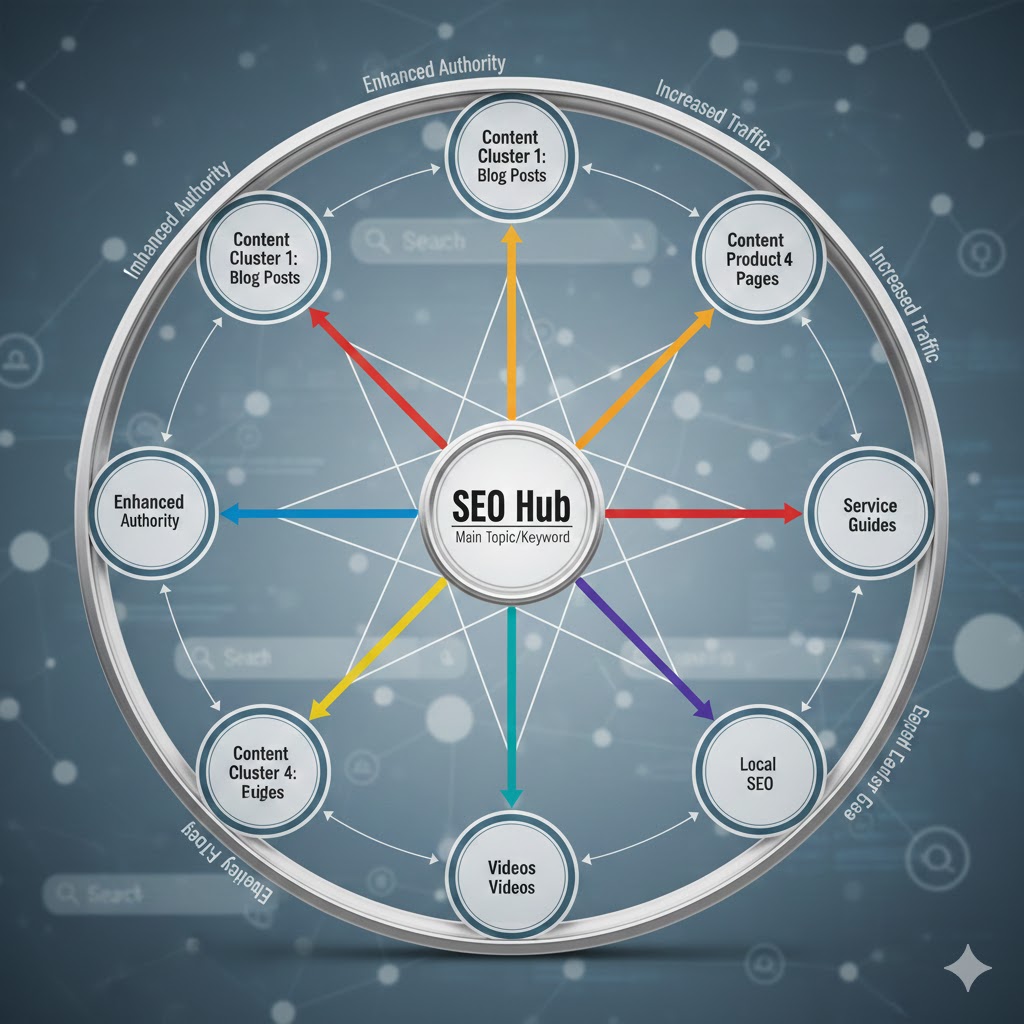
Think of a hub page like the center of a bicycle wheel. It’s the main page about a big topic, and it connects to lots of smaller, more detailed pages (the “spokes”) that branch out from it. A hub page gives a broad overview and then says, “Want to know more about this specific part? Click here!”
Real-World Example
InterCore’s Legal Marketing Hub is a hub page. It covers the broad topic of “legal marketing” and links out to dozens of more specific pages — like pages about SEO for lawyers, social media marketing, content creation, and more.
Why Hub Pages Matter for SEO, GEO & AEO
| Channel | Why Hub Pages Help |
|---|---|
| SEO | Google sees all those connected pages and thinks, “This website really knows this topic!” — which builds what experts call “topical authority.” |
| GEO | AI tools like ChatGPT can crawl hub pages to understand the full range of services a firm offers, making them more likely to recommend the firm. |
| AEO | Hub pages contain structured overviews that answer engines can extract for summary answers in featured snippets and AI Overviews. |
Key Characteristics
- Covers a broad topic comprehensively (1,500–3,000+ words)
- Links to 6–12 related “spoke” pages
- Uses the main, competitive keyword (e.g., “legal marketing”)
- Includes a table of contents for easy navigation
- Updated regularly as new spoke content is added
🔗 Spoke Pages (Cluster Content)
The Simple Explanation
If hub pages are the center of the wheel, spoke pages are the individual spokes that extend outward. Each spoke page takes one small piece of the big topic and goes really deep into it. It’s like the difference between a chapter title in a textbook (the hub) and the actual chapter that explains everything in detail (the spoke).
Real-World Example
Under InterCore’s GEO hub, individual spoke pages include guides like How to Optimize for ChatGPT, Perplexity AI Optimization, and GEO vs. SEO: The Complete Comparison Guide. Each one dives deep into a specific sub-topic.
Key Characteristics
- Targets a specific, long-tail keyword (e.g., “how to optimize for ChatGPT” rather than just “AI marketing”)
- Always links back to its hub page
- Cross-links to 1–2 related spoke pages
- Usually 1,500–2,500 words
- Contains detailed, actionable information that a hub page only summarizes
The Hub ↔ Spoke Relationship
Here’s the key rule: every spoke links back to its hub, and the hub links out to every spoke. This creates a web of connections that search engines and AI tools love. It tells them, “All of these pages are related, and together they cover this topic completely.” This is exactly how authority signals get built for both traditional search and AI platforms.
📍 Local Service Pages
The Simple Explanation
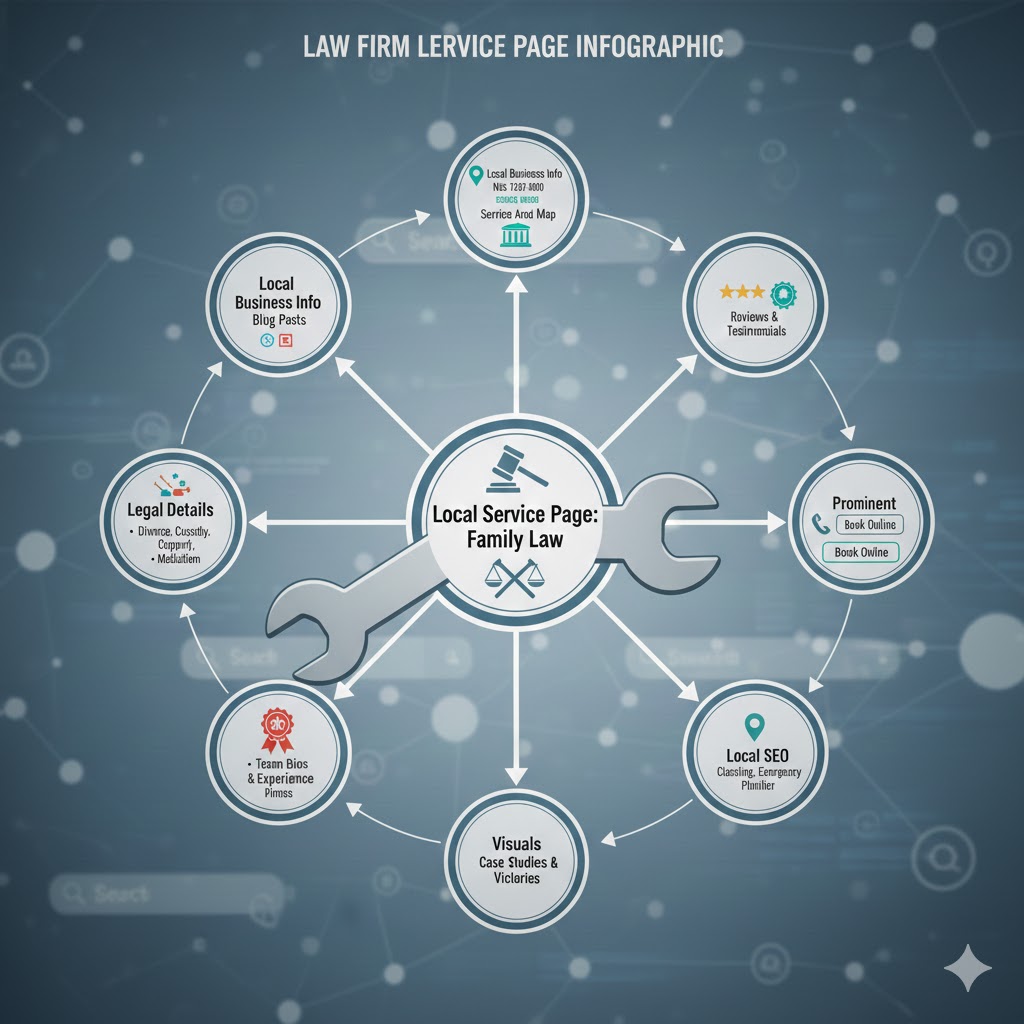
A local service page is like a custom welcome sign for each city you serve. It tells people (and search engines), “Yes, we work in THIS specific city, and here’s what we do there.” It’s different from your general service page because it includes details about that particular location — like local court names, neighborhood references, and city-specific data.
Real-World Example
InterCore has local service pages for cities across the country, like Los Angeles Law Firm SEO Services and San Francisco AI Legal Marketing. Each page includes information specific to that city’s legal market.
Why Local Pages Are Critical
When someone asks ChatGPT or Google, “Who is the best personal injury lawyer in San Diego?” — the AI needs to find pages that specifically mention San Diego and personal injury law. A generic page that says “we serve all of California” won’t be as useful as a dedicated San Diego page with local statistics, court information, and neighborhood details.
What Makes a Good Local Service Page
- City name in the H1 heading and throughout the content
- Local statistics (population, number of attorneys, case types)
- NAP information (Name, Address, Phone number) for that location
- LegalService schema markup with city-level
areaServed - Links back to the Areas We Serve directory hub
- References to local courts, neighborhoods, or landmarks
⚠️ Limitations:
Local service pages must contain genuinely unique, location-specific content. Simply swapping city names on otherwise identical templates can trigger duplicate content penalties from search engines. Each city page should include unique local data, specific service details, and distinct community references.
⚖️ Practice Area Pages
The Simple Explanation
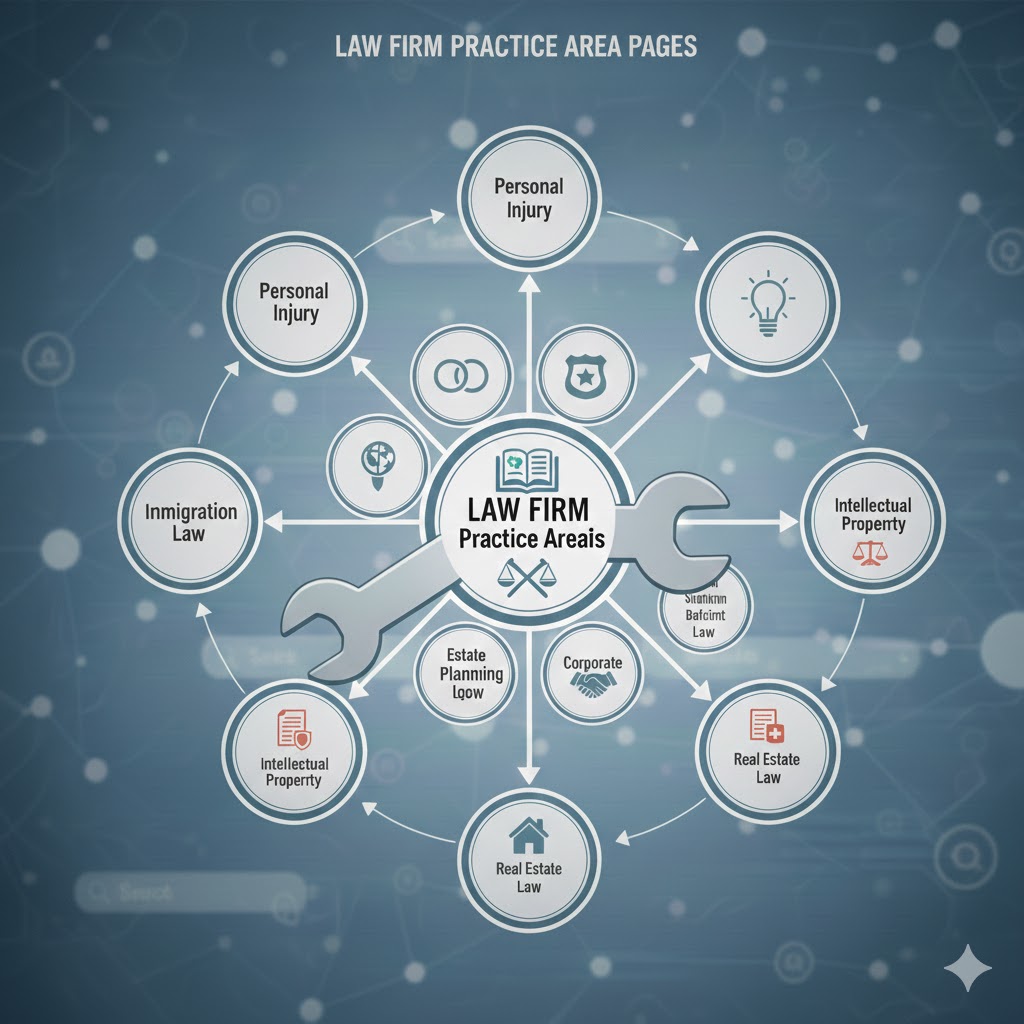
Practice area pages are like department signs in a hospital. A hospital has a cardiology department, an emergency room, and a pediatrics wing. A law firm website has a personal injury page, a family law page, and a criminal defense page. Each one explains what that area of law is about and how the firm helps with it.
How They Differ from Local Service Pages
A practice area page focuses on the type of law (personal injury, family law, etc.), while a local service page focuses on the location (Los Angeles, San Diego, etc.). Some websites combine both — creating pages like “Personal Injury Lawyer in San Diego” — which functions as both a practice area page and a local service page. InterCore’s Personal Injury Marketing solutions page is a good example of a practice area hub.
Key Characteristics
- Explains the practice area in clear, client-friendly language
- Answers the most common questions people have about that area of law
- Includes case types handled, typical outcomes, and the firm’s process
- Links to related FAQ pages, blog posts, and location-specific pages
- Uses schema markup (typically LegalService or ProfessionalService) to tell search engines what kind of service this page describes
❓ FAQ Pages
The Simple Explanation
FAQ pages are like a Q&A session with your teacher after class. They list the most common questions people ask about a topic and give clear, straightforward answers. They’re one of the most powerful page types for AEO because AI answer engines love pulling from well-structured question-and-answer formats.
Why FAQ Pages Are Gold for AI Visibility
When someone asks ChatGPT, “How long does a personal injury case take?” — the AI is looking for a page that literally has that question as a heading and a clear answer underneath. FAQ pages are built exactly this way, making them extremely easy for AI systems to understand and cite. InterCore’s FAQ Knowledge Snippets guide explains how to structure these for maximum AI search visibility.
Key Characteristics
- Questions as H2 or H3 headings, written exactly how real people ask them
- Answers that start with a direct response in the first 1–2 sentences, then expand
- 50–150 words per answer (enough to be thorough, short enough to be extractable)
- FAQPage schema markup — this special code tells Google, “This is a FAQ page” and can earn you rich results in search
- Accordion-style formatting (click to expand) for user-friendly browsing
✅ Best Practice:
Create standalone FAQ pages for each major topic area (e.g., GEO Strategy FAQ, ChatGPT Law Firm Recommendations FAQ) AND include a FAQ section at the bottom of your service pages. This gives you double coverage — the standalone page targets broad informational queries, while the embedded FAQ enhances the parent page.
✏️ Blog Posts & Educational Articles
The Simple Explanation
Blog posts are like newspaper articles or magazine features about your area of expertise. They cover timely topics, explain complicated ideas, share news, or provide how-to guides. Unlike service pages (which stay mostly the same), blog posts are published regularly with fresh, new content.
Types of Blog Posts
Not all blog posts are the same. Here are the main types you’ll find on law firm websites:
| Blog Type | Purpose | Example |
|---|---|---|
| How-To Guide | Teaches readers step by step | How to Get Listed on ChatGPT |
| Thought Leadership | Shares expert opinions and analysis | AI SEO Secrets for 2026 |
| News/Updates | Covers industry developments | AI Executive Order Analysis |
| Research Deep-Dive | Analyzes data and studies | LLM Context Windows Comparison |
| Listicle/Roundup | Curates the best resources or tools | Best AI Tools for Law Firm Marketing |
Blog posts are powerful spoke pages in a hub-and-spoke architecture. Each post should link back to its parent hub page and to 1–2 related posts. According to research on content publishing frequency for AI visibility, regular publishing of high-quality blog content is one of the strongest signals for both traditional search rankings and AI platform citations.
🎯 Landing Pages (Conversion Pages)
The Simple Explanation
A landing page is like a checkout counter at a store. While other pages educate and inform, a landing page has one job: get the visitor to take a specific action. That might be filling out a contact form, scheduling a consultation, calling the office, or downloading a guide.
Key Characteristics
- One clear call-to-action (CTA) — not five different things to click on
- Minimal navigation (you don’t want people clicking away)
- A compelling headline that matches whatever ad or link brought the person there
- Social proof: testimonials, case results, trust badges
- Contact form or phone number prominently displayed
Landing Pages vs. Service Pages
Here’s the difference: a service page educates visitors about what you do and tries to rank in organic search. A landing page is laser-focused on conversion — it usually receives traffic from paid ads (Google Ads, social media ads) rather than organic search. Some firms use both: the service page attracts organic traffic, and the landing page handles paid traffic.
🛠️ Resource & Tool Pages
The Simple Explanation
Resource pages are like free tool kits. They offer something useful — a calculator, a checklist, a downloadable template, or an interactive tool — that visitors can use for free. They build trust and demonstrate expertise while attracting links from other websites.
Examples
InterCore offers several resource and tool pages, including the Attorney Schema Generator (a free tool that creates schema markup code for law firms), the ROI Calculator, and the comprehensive 200-Point SEO Audit Checklist.
Why They’re Important for GEO
Resource pages earn backlinks naturally — when other websites link to your free tool, it signals authority to both search engines and AI platforms. They also demonstrate the Experience component of Google’s E-E-A-T framework, showing that your firm doesn’t just talk about expertise — it builds tools that prove it.
⚖️ Comparison & Versus Pages
The Simple Explanation
Comparison pages are like those “taste test” videos where someone tries two different sodas side by side. They take two (or more) options that people are trying to decide between and compare them clearly — explaining the differences, pros and cons, and which one is better for different situations.
Real-World Example
InterCore’s GEO vs. SEO Comparison Guide and Google Ranking vs. ChatGPT Recommendations are comparison pages. They help readers understand the differences between two approaches so they can make informed decisions.
Why AI Loves Comparison Pages
When someone asks ChatGPT, “What’s the difference between GEO and SEO?” — the AI is specifically looking for comparison content. Pages with clear side-by-side tables, pros/cons lists, and direct “A vs. B” formatting are extremely easy for AI systems to cite. These pages target commercial intent queries — people who are actively evaluating options and are closer to making a decision.
Key Characteristics
- Side-by-side comparison table in a structured format
- Clear “winner” recommendations for different use cases
- Balanced, neutral tone (even if you have a preference)
- Targets “[A] vs. [B]” keywords that people search for
📊 Case Study & Results Pages
The Simple Explanation
Case study pages are like report cards that show your actual grades. Instead of just saying, “We’re great at what we do,” they show real examples of work you’ve done and the results you achieved. They tell a story: here was the problem, here’s what we did, and here’s what happened.
Why They Build Trust
Both human readers and AI systems give more weight to claims backed by evidence. A case study that says “We increased organic traffic by 312% for a personal injury firm in 8 months” is far more convincing — and more citable by AI — than simply claiming “We get great results.”
Key Characteristics
- Clear structure: Challenge → Solution → Results
- Specific, quantifiable metrics (percentages, dollar amounts, timeframes)
- Client industry and practice area context
- Testimonial quotes where possible
- Serves as powerful E-E-A-T evidence (Experience + Trust)
⚠️ Limitations:
Case study results are specific to individual clients and depend on many factors including market competition, budget, timeline, and starting position. Past results do not guarantee identical outcomes for other firms. Always present case studies with appropriate context about the conditions that contributed to the results.
📖 Glossary & Definition Pages
The Simple Explanation
Glossary pages are like a dictionary for your industry. They define important terms that your audience might not know. For a law firm, this might include terms like “statute of limitations,” “contingency fee,” or “discovery process.” For a legal marketing agency, it might include terms like “schema markup,” “Generative Engine Optimization,” or “E-E-A-T.”
Why They’re AEO Superstars
Definition pages are perhaps the single most powerful page type for Answer Engine Optimization. When someone asks, “What is Generative Engine Optimization?” — AI tools want a clear, concise definition. A well-structured definition page with the question as a heading and a direct 30–60 word answer in the first paragraph is exactly what answer engines extract. InterCore’s page on What Is Generative Engine Optimization (GEO)? follows this format.
Key Characteristics
- Term name as the H1 or H2 heading
- Clear, jargon-free definition in the first 1–2 sentences
- Expanded explanation with context and examples
- DefinedTerm schema markup can be used for enhanced search visibility
- Links to related terms and deeper spoke content
👥 About & Team Pages
The Simple Explanation
About pages are like the “About the Author” section at the back of a book. They tell visitors who you are, what your company does, and why people should trust you. Team pages show the individual people who work at the company along with their qualifications and experience.
Why They Matter for E-E-A-T
Google’s E-E-A-T framework (Experience, Expertise, Authoritativeness, Trustworthiness) heavily relies on about and team pages to verify that real people with real credentials stand behind the content. AI platforms also use these pages to determine whether to cite a source. A law firm without a clear “About” page looks less trustworthy to both humans and machines.
Key Characteristics
- Company history, mission, and values
- Individual team member bios with credentials, education, and experience
- Professional headshot photos
- Person schema markup with
sameAslinks to LinkedIn profiles and other verified presences - Links to published work, speaking engagements, or media mentions
🗺️ Directory & Location Index Pages
The Simple Explanation
A directory page is like the big map at a shopping mall that shows where every store is. For websites, it’s a single page that lists and links to all of a certain type of content — usually all your office locations, all your practice areas, or all your service pages. It helps visitors (and search engines) see everything in one place.
The Hub of Hubs
Directory pages function as hub pages for your location or service spokes. InterCore’s Areas We Serve directory page connects to 35+ individual office pages across the country. Each local service page links back to this directory, creating a clean hub-and-spoke structure specifically for geographic coverage.
Key Characteristics
- Organized listings (by state/region, alphabetically, or by practice area)
- Brief descriptions for each listing with links to detailed pages
- Search or filter functionality for larger directories
- BreadcrumbList schema to create clear navigation paths
- Critical for internal linking strategy — the directory distributes link equity to all spoke pages
🧩 How All These Pages Work Together
No page type works alone. The real power comes from how they connect to each other. Here’s how a well-built law firm website architecture looks:
🏗️ Website Architecture Map
Level 1 — Homepage → Links to all major hubs
Level 2 — Hub Pages → Legal Marketing Hub, GEO Services Hub, Areas We Serve Directory
Level 3 — Spoke Pages → Individual service pages, practice area pages, local service pages, blog posts
Supporting Pages → FAQ pages, glossary pages, comparison pages, case studies, resource/tool pages
Trust Pages → About page, team pages, contact page
The Internal Linking Rules
Here’s a summary of how different page types should link to each other:
| Page Type | Must Link To | Should Also Link To |
|---|---|---|
| Local Service Page | Areas We Serve hub | 1–2 nearby location pages |
| Practice Area Page | Legal Marketing hub | Related blog posts, FAQ pages |
| GEO Spoke Page | GEO Services hub | 1–2 related GEO spokes |
| Blog Post | Parent hub page | Related service pages, other blog posts |
| FAQ Page | Parent service page | Glossary definitions, related FAQs |
| Comparison Page | Both compared service pages | Related decision-making content |
📏 Measurement Framework
Building the right page types is only half the job. You also need to measure whether they’re working. Here’s a practical framework for tracking your website’s performance across SEO, GEO, and AEO channels:
Example Measurement Framework
- Baseline documentation: Before implementation, test 20–50 relevant queries across ChatGPT, Perplexity, Google AI Overviews, and Copilot. Record which pages (yours and competitors’) appear in responses.
- Query set definition: Define target queries based on each page type — informational queries for blog posts and glossaries, local queries for location pages, comparison queries for versus pages.
- Measurement cadence: Monthly or bi-weekly testing of the defined query set across all AI platforms.
- Reporting metrics: Track mention rate (how often your brand appears), citation rate (how often your URL is cited), accuracy rate (are AI responses about you correct?), and competitor comparison.
- Page-type analysis: Identify which page types generate the most AI citations and allocate content resources accordingly.
⚠️ Limitations:
AI platform citation measurement is still an emerging field. There are no standardized tools for tracking AI visibility at scale, and results can vary significantly between query sessions due to the non-deterministic nature of large language models. The framework above represents current best practices based on practitioner observations, not guaranteed methodology.
❓ Frequently Asked Questions
What is the difference between a hub page and a spoke page?
A hub page covers a broad topic at a high level and acts as the central connecting point for related content. A spoke page takes one specific sub-topic from that hub and goes into much greater detail. Think of the hub as the table of contents of a book and each spoke as an individual chapter. The hub links out to all its spokes, and each spoke links back to the hub — creating a connected network that search engines and AI platforms recognize as comprehensive topic coverage.
How many page types does my law firm website actually need?
At minimum, most law firm websites should have a homepage, practice area pages, an about/team page, a contact page, and a blog. For firms looking to compete seriously in both traditional search and AI platforms, adding local service pages, FAQ pages, a glossary section, and resource/tool pages significantly expands visibility. The exact number depends on your practice areas, geographic coverage, and competitive market.
Which page type is most important for getting recommended by ChatGPT?
FAQ pages and definition/glossary pages tend to perform best for AI citations because they are structured in a question-and-answer format that AI models can easily extract. However, a comprehensive hub-and-spoke architecture — where hub pages demonstrate breadth and spoke pages demonstrate depth — gives AI platforms the strongest overall signal that your firm is an authority on a topic. No single page type is a silver bullet; the combination matters most.
What is the difference between SEO, GEO, and AEO?
SEO (Search Engine Optimization) focuses on ranking your pages higher in traditional search engine results like Google’s blue links. GEO (Generative Engine Optimization) focuses on getting your content cited by AI platforms like ChatGPT, Perplexity, and Google’s AI Overviews. AEO (Answer Engine Optimization) focuses specifically on becoming the direct answer that featured snippets, voice assistants, and AI summary boxes display. There is significant overlap — well-structured, authoritative content performs well across all three — but each has specific technical requirements and optimization strategies.
Do I need different schema markup for different page types?
Yes. Schema markup is the structured code that tells search engines exactly what type of content a page contains. Different page types require different schema types: FAQ pages use FAQPage schema, local service pages use LegalService or LocalBusiness schema with areaServed properties, blog posts use Article schema, how-to guides use HowTo schema, and glossary pages can use DefinedTerm schema. Using the correct schema for each page type significantly increases your chances of earning rich results in Google Search and being accurately cited by AI platforms.
How do local service pages differ from practice area pages?
The key difference is the organizing principle. A practice area page is organized around a type of legal service (personal injury, family law, criminal defense) and explains what that service involves regardless of location. A local service page is organized around a geographic area (San Diego, Los Angeles, Chicago) and explains what services are available in that specific location. Many effective websites create pages that combine both — “Personal Injury Lawyer in San Diego” — which targets both the practice area keyword and the local keyword simultaneously.
What makes a page “citable” by AI platforms?
Research published at the 30th ACM SIGKDD Conference on Knowledge Discovery and Data Mining (KDD ’24) by Aggarwal et al. identified several factors that make content more likely to be cited by generative AI engines. These include using authoritative language, citing credible sources, writing in a neutral and factual tone, including relevant statistics with proper attribution, and structuring content with clear headings and direct answers. Pages that are well-organized, factually accurate, and technically enhanced with proper schema markup tend to receive more AI citations than promotional or vaguely written content.
Ready to Build a Website That Works Across Every Search Platform?
InterCore Technologies has been building AI-powered digital strategies for law firms since 2002. Let our team audit your current website architecture and create a page-type strategy optimized for SEO, GEO, and AEO.
📚 References
- Aggarwal, P., Murahari, V., Rajpurohit, T., Kalyan, A., Narasimhan, K., & Deshpande, A. (2024). GEO: Generative Engine Optimization. In Proceedings of the 30th ACM SIGKDD Conference on Knowledge Discovery and Data Mining (KDD ’24), Barcelona, Spain, August 25–29, 2024, pp. 5–16. DOI: 10.1145/3637528.3671900
- Pew Research Center. (2025, June 25). “34% of U.S. adults have used ChatGPT, about double the share in 2023.” Survey of 5,123 U.S. adults, February 24–March 2, 2025. https://www.pewresearch.org/short-reads/2025/06/25/34-of-us-adults-have-used-chatgpt-about-double-the-share-in-2023/
- Google Search Central. (2026). Introduction to Structured Data Markup in Google Search. https://developers.google.com/search/docs/appearance/structured-data/intro-structured-data
- First Page Sage. (2024). “The Best SEO Content Plan: The Hub & Spoke Model.” https://firstpagesage.com/advanced-seo/best-seo-content-plan-the-hub-and-spoke-model-fc/
- CXL. (2026). “Answer Engine Optimization (AEO): The Comprehensive Guide for 2026.” https://cxl.com/blog/answer-engine-optimization-aeo-the-comprehensive-guide-for-2025/
- Conductor. (2025). “Topic Cluster and Pillar Page SEO Guide.” https://www.conductor.com/academy/topic-clusters/
- Gartner. (2025). Prediction: “By 2026, 25% of organic search traffic will shift to AI chatbots and virtual assistants.” Referenced in multiple industry publications.
Conclusion
Building a website that performs across traditional search engines, AI answer platforms, and generative engines isn’t about creating any single “magic” page type. It’s about building a complete ecosystem where hub pages, spoke pages, local service pages, FAQ pages, glossary definitions, comparison guides, and resource tools all work together — connected by strategic internal links and enhanced with proper schema markup.
The firms that will win in 2026 and beyond are those building their website architecture with all three optimization approaches — SEO, GEO, and AEO — in mind from the start. Each page type serves a purpose, and together they form the content foundation that both human visitors and AI systems use to evaluate your expertise and trustworthiness.
Whether you’re starting from scratch or improving an existing site, begin by mapping your current pages to the types described in this guide. Identify the gaps — maybe you’re missing FAQ pages, or your local pages lack unique content — and build from there. For a professional assessment, explore InterCore’s 200-Point SEO Technical Audit Checklist as a starting point.
Scott Wiseman
CEO & Founder, InterCore Technologies
Scott has led InterCore Technologies since 2002, pioneering AI-powered marketing solutions for law firms across the United States. With 23+ years of development experience, he specializes in Generative Engine Optimization (GEO) and AI search strategies that help law firms get found by both traditional search engines and AI platforms.
📅 Published: February 10, 2026 | Last Updated: February 10, 2026 | ⏱️ 15 min read