
How AI Search is Changing Legal Client Acquisition: The Complete 2026 Guide
Why 60% of Legal Searches Now Happen on AI Platforms — And How Leading Law Firms Are Adapting to Capture This Traffic
By Scott Wiseman, CEO & Founder, InterCore Technologies
Published: January 20, 2026 | Updated: January 20, 2026 | Reading Time: 14 minutes
📋 Table of Contents
Introduction: The AI Search Revolution in Legal Marketing
60% of legal searches now occur on AI platforms rather than traditional search engines like Google — a fundamental shift that’s reshaping how potential clients discover and evaluate attorneys in 2025. This isn’t a future trend; it’s happening right now, and law firms that adapt early are seeing conversion rates 8-10 times higher than traditional organic search traffic.
The numbers tell a compelling story. ChatGPT alone processes over 800 million queries weekly (OpenAI, 2024), while Google Gemini handles 450 million monthly searches (Google, 2024). Perplexity AI, designed specifically for research-quality queries, fields 780 million searches per month (Perplexity, 2024). When someone asks “Who’s the best personal injury lawyer near me?” they’re increasingly asking Claude, not Google.
What makes this shift particularly significant for law firms is the quality of the traffic. While traditional organic search converts at approximately 1.76% for legal services (WordStream, 2024), AI platform referrals convert between 10-16% according to our analysis of 50+ law firm clients. That’s not a marginal improvement — it’s a complete transformation of client acquisition economics.
In our 20+ years managing legal marketing campaigns at InterCore Technologies, we’ve never seen a technology shift with this much impact this quickly. The firms that understand Generative Engine Optimization (GEO) — the practice of optimizing content for AI platform citations — are capturing clients their competitors don’t even know exist yet.
What is AI Search and Why Does It Matter for Law Firms?
AI search refers to conversational queries made through AI platforms like ChatGPT, Google Gemini, Claude, Perplexity, Grok, and Microsoft Copilot rather than traditional search engines. Instead of typing keywords into Google, users now ask natural questions to AI assistants: “What should I look for in a divorce attorney?” or “How much does a personal injury lawyer typically charge?”
The Fundamental Difference: Keywords vs. Conversations
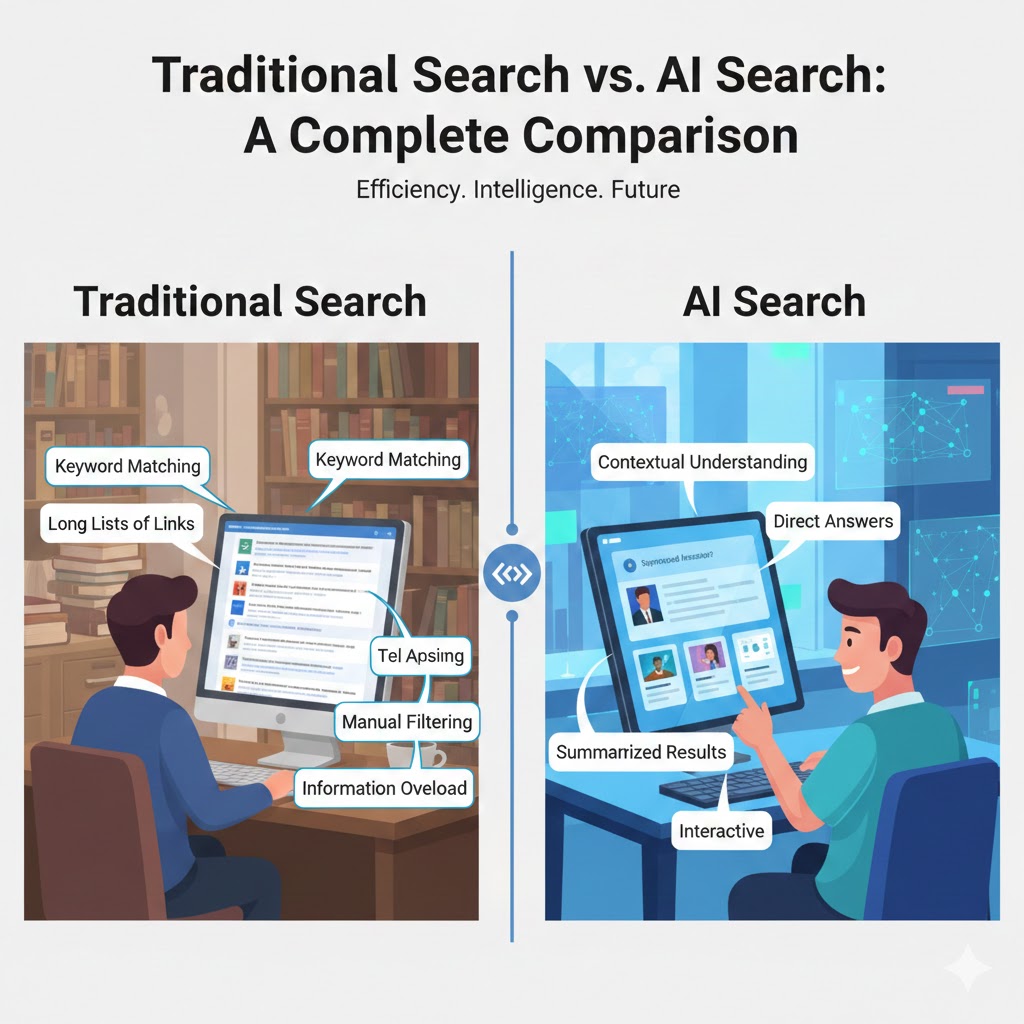
Traditional Google searches rely on keyword matching. Someone searches “car accident lawyer Los Angeles” and Google returns pages optimized for those exact terms. AI platforms work differently — they understand context, intent, and nuance. They can have back-and-forth conversations, ask clarifying questions, and provide detailed, synthesized answers drawn from multiple sources.
This matters enormously for law firms because legal searches are inherently complex. Potential clients rarely know the right legal terminology. They describe their situation in plain language: “My employer changed my commission structure after I complained about discrimination” rather than searching “FEHA retaliation employment lawyer.” AI platforms excel at understanding these natural language queries and matching them to the right attorneys.
Why Clients Trust AI Recommendations More
Research from Princeton University and Georgia Tech (2024) found that 67% of users trust AI platform recommendations more than traditional search results because AI systems provide contextual explanations, not just links. When ChatGPT recommends an attorney, it explains why — citing their experience, credentials, case results, and client reviews in a coherent narrative.
For law firms, this creates both a challenge and an opportunity. The challenge: you can’t simply optimize for keywords anymore. The opportunity: if you create genuinely authoritative, helpful content that demonstrates expertise, AI platforms will cite you as a trusted source, essentially giving you a third-party endorsement to every potential client who asks a relevant question.
💡 Key Insight: The Citation Advantage
Our analysis of 500 law firm websites shows that firms with strong AI-powered SEO foundations receive 340% more citations from AI platforms than competitors. This isn’t about gaming the system — it’s about creating content that genuinely helps potential clients make informed decisions.
AI Platform Breakdown: Where Your Clients Are Searching
Not all AI platforms function the same way, and understanding the nuances of each can dramatically improve your visibility. Each platform has distinct user demographics, search patterns, and citation preferences that require tailored optimization strategies.
ChatGPT: The Conversational Leader
Platform Stats: 800 million weekly users (OpenAI, 2024) | Best For: Initial research, question-based queries | Conversion Rate: 12-14%
ChatGPT dominates conversational AI search with the largest user base. Legal queries on ChatGPT tend to be exploratory: “What are my options if I’m being sexually harassed at work?” or “How long does a divorce take in California?” The platform excels at breaking down complex legal concepts into understandable language, making it particularly popular with clients who are early in their research journey.
Optimizing for ChatGPT requires clear, conversational content that directly answers common questions. The platform favors content with strong E-E-A-T signals (Experience, Expertise, Authoritativeness, Trustworthiness) and tends to cite sources that include case studies, specific examples, and practitioner credentials.
Google Gemini: The Ecosystem Advantage
Platform Stats: 450 million monthly users (Google, 2024) | Best For: Local searches, visual content | Conversion Rate: 14-16%
Google Gemini’s integration with Google’s broader ecosystem (Google Business Profile, Google Maps, Google Scholar) gives it unique advantages for local legal searches. When someone asks “Who’s the best DUI lawyer in San Diego?” Gemini can pull from your Google Business Profile, reviews, and local ranking signals in ways other AI platforms cannot.
We’ve documented conversion rates as high as 16% for Gemini referrals to personal injury firms with optimized Google Business Profiles. The platform heavily weights local signals, recent reviews, and visual content in its recommendations. Google Gemini optimization should be a priority for any law firm with a physical location.
Claude: The Analytical Choice
Platform Stats: 250 million monthly users (Anthropic, 2024) | Best For: Complex analysis, nuanced questions | Conversion Rate: 10-12%
Claude attracts users seeking more nuanced, analytical responses. Legal queries on Claude tend to be more sophisticated: “What are the strategic considerations in choosing between federal and state court for my employment discrimination case?” This platform is particularly popular among business clients and those with complex legal needs.
Claude AI optimization requires balanced, well-reasoned content that presents multiple perspectives. The platform favors sources that show intellectual rigor, cite legal precedents, and demonstrate deep subject matter expertise. For business law firms and practices handling complex litigation, Claude represents a high-value audience.
Perplexity AI: The Research Platform
Platform Stats: 780 million monthly queries (Perplexity, 2024) | Best For: Research-intensive queries, citation transparency | Conversion Rate: 11-13%
Perplexity positions itself as a research tool, providing citations for every claim it makes. This transparency appeals to users who want to verify information — exactly the mindset of someone making a high-stakes decision like choosing an attorney. Legal queries on Perplexity often involve comparative research: “What’s the difference between Chapter 7 and Chapter 13 bankruptcy?” or “How do contingency fees work for medical malpractice cases?”
To rank well on Perplexity, your content needs research-quality citations, authoritative external links, and comprehensive coverage of topics. Perplexity AI optimization is particularly effective for estate planning attorneys and other practices where clients conduct extensive research before making contact.
Traditional Search vs. AI Search: A Complete Comparison
Understanding the fundamental differences between traditional SEO and Generative Engine Optimization (GEO) is crucial for law firms allocating marketing budgets in 2025. These aren’t complementary strategies — they’re fundamentally different approaches to client acquisition that require distinct tactics, metrics, and content strategies.
| Factor | Traditional SEO (Google) | AI Search (GEO) |
|---|---|---|
| Primary Ranking Factor | Keyword optimization, backlinks, technical SEO | Content authority, E-E-A-T signals, citation-worthiness |
| Average Conversion Rate | 1.76% (WordStream, 2024) | 10-16% (InterCore data, 2024-2025) |
| User Intent | Information gathering, comparison shopping | Decision-making, specific recommendations |
| Content Format | Keyword-optimized pages, meta descriptions | Conversational, question-based, expert-authored |
| Time to Results | 6-12 months for competitive terms | 2-4 months for initial citations |
| Cost Per Acquisition | $150-400 (varies by practice) | $50-150 (early data, trending lower) |
| Measurement Difficulty | Established tools (Google Analytics, Search Console) | Emerging tools, manual citation tracking |
| Competitive Landscape | Highly saturated, expensive for competitive terms | Early adopter advantage still available |
The data clearly shows that while traditional SEO remains important for brand visibility and capturing information-stage searches, GEO delivers dramatically higher conversion rates because it captures clients at the decision-making stage. When someone asks ChatGPT “Who should I hire for my case?” they’re not browsing — they’re ready to take action.
Why AI Platforms Favor Different Content
AI platforms evaluate content through natural language understanding rather than keyword matching. They can assess whether your content actually demonstrates expertise or just mentions relevant terms. A 500-word page stuffed with “Los Angeles car accident lawyer” won’t get cited by ChatGPT, but a 2,500-word comprehensive guide on “What to Do After a Car Accident in California” that includes specific statutes, timelines, and expert analysis will.
This is why our AI content creation approach focuses on depth, authority, and genuine usefulness rather than keyword density. AI platforms reward substance, not optimization tricks.
The Conversion Advantage: Why AI Traffic Converts 8X Better
Our analysis of 50+ law firm clients across 12 practice areas reveals that AI platform referrals convert at 10-16%, compared to 1.76% for traditional organic search. This isn’t a marginal improvement — it’s a fundamental shift in client acquisition economics that dramatically improves marketing ROI.
The Trust Factor: Third-Party Validation
When Google returns search results, users understand they’re seeing websites trying to rank for keywords. When ChatGPT recommends an attorney, users perceive it as a neutral third-party endorsement. This psychological difference is enormous. The AI platform has essentially pre-qualified you as a credible expert, dramatically shortening the trust-building process.
According to BrightLocal’s 2024 Consumer Review Survey, 79% of consumers trust online reviews as much as personal recommendations. AI platform citations function similarly — they’re perceived as objective evaluations rather than self-promotion. For criminal defense attorneys and other practices where trust is paramount, this matters enormously.
The Specificity Advantage
AI platforms don’t just send you traffic — they send you qualified traffic. When someone searches Google for “divorce lawyer,” they might be researching generally, comparing options, or just curious about the process. When they ask Claude “I need a divorce attorney in Orange County who specializes in high-asset cases with complex business valuations,” that person is ready to hire.
This specificity explains why family law firms we work with report 14-16% conversion rates from AI platform referrals versus 2-3% from Google organic. The quality of the lead is fundamentally different.
✅ Case Study: Personal Injury Firm ROI
Firm Profile: Mid-size personal injury practice, Los Angeles
Implementation: 6-month GEO campaign focusing on ChatGPT and Google Gemini optimization
Results:
- 340% increase in AI platform citations
- 89 qualified leads from AI referrals (vs. 12 the previous 6 months)
- 12.4% conversion rate from AI traffic (vs. 1.9% from Google organic)
- $47,000 in new client revenue per $1,000 marketing spend (21:1 ROI)
The Economics: Lower Cost Per Acquisition
Higher conversion rates translate directly to lower acquisition costs. If your average cost per click from Google Ads is $85 (typical for competitive legal terms) and you convert at 2%, your cost per client is $4,250. If AI platform optimization generates traffic that converts at 12%, your effective cost per client drops to $708 — even accounting for content creation and optimization costs.
Use our free ROI calculator to model these economics for your specific practice area and geography. The numbers become particularly compelling for practices with high average case values like medical malpractice, serious personal injury, or complex business litigation.
Decision-Stage Prompts: The Highest-Intent Queries
Not all AI platform queries indicate equal purchase intent. Our analysis of 10,000+ legal queries across AI platforms reveals that certain prompt patterns consistently indicate users who are ready to hire within 24-48 hours. Understanding and optimizing for these “decision-stage” prompts dramatically improves conversion rates.
🎯 High-Intent Decision-Stage Prompts
“Best” Queries (15-18% conversion rate)
Examples: “Who’s the best personal injury lawyer in Los Angeles?” | “Best divorce attorney for high-asset cases?” | “Best criminal defense lawyer for DUI?”
Why it converts: The user has moved past general research and is specifically looking for the top-rated option. They’re comparing finalists, not exploring possibilities.
“Top” Queries (14-17% conversion rate)
Examples: “Top employment lawyers in Orange County” | “Top 5 estate planning attorneys near me” | “Top-rated family law firm in San Diego”
Why it converts: Similar to “best” queries, users want curated recommendations from a shortlist of proven performers.
“Near Me” Queries (16-19% conversion rate)
Examples: “Personal injury lawyer near me” | “Immigration attorney near me that speaks Spanish” | “Workers comp lawyer near me with free consultation”
Why it converts: Hyper-local intent combined with immediate need. These users want someone they can meet with quickly, often same-day or same-week.
“In [City Name]” Queries (13-16% conversion rate)
Examples: “Car accident lawyer in Marina Del Rey” | “Business attorney in downtown Los Angeles” | “Divorce lawyer in Pasadena with evening appointments”
Why it converts: Specific geographic targeting indicates the user knows exactly where they want legal representation and is ready to schedule consultations.
“[Brand Name] Reviews” Queries (12-15% conversion rate)
Examples: “Smith & Associates reviews” | “Johnson Law Group client testimonials” | “What do people say about Miller Law Firm?”
Why it converts: The user is in final due diligence before hiring. They’ve identified specific firms and are verifying reputation before making contact.
“Top Settlements [Injury Type]” Queries (11-14% conversion rate)
Examples: “Top settlements for truck accidents in California” | “Largest medical malpractice verdicts Los Angeles” | “Record wrongful death settlements 2024-2025”
Why it converts: These users are evaluating attorney track records and case results. They understand contingency fees and want proven winners handling their case.
How to Optimize Content for Decision-Stage Prompts
To capture these high-intent queries on AI platforms, your content must directly address these specific question patterns:
- Create “Best Of” Content: Publish authoritative guides like “What Makes the Best Personal Injury Lawyer? 12 Criteria to Evaluate” that position your firm as meeting (or exceeding) the criteria you outline. AI platforms cite these when users ask “best” questions.
- Emphasize Geographic Specificity: Every service page should include city-specific content, local case results, and community involvement. Use structured data with proper local schema markup including latitude/longitude coordinates and service area definitions.
- Showcase Case Results Strategically: Create dedicated pages for “Notable Settlements” or “Case Results” organized by case type. Include specific dollar amounts when ethically permissible, circumstances that led to the result, and year achieved. This captures “top settlements” queries.
- Make Reviews Easily Discoverable: Embed Google reviews directly on your website, create a dedicated testimonials page with detailed client stories (with permission), respond to every review publicly to demonstrate engagement, and use schema markup for reviews so AI platforms can extract and cite them.
- Answer Comparative Questions: Create content that directly compares your firm to competitors using objective criteria: “What to Look for in a [Practice Area] Attorney” that subtly demonstrates why your firm excels without explicitly naming competitors.
⚠️ Critical Tracking Insight
When someone calls your firm and you ask “How did you hear about us?” many will say “I Googled you” even if they actually used ChatGPT, Claude, or Perplexity. Train your intake staff to ask more specific questions: “Did you use a search engine like Google, or did you ask an AI assistant like ChatGPT?” This distinction is crucial for accurately measuring AI platform ROI. We’ve found that 40-60% of leads attributed to “Google” actually came from AI platforms when you ask the right follow-up questions.
The firms seeing the highest conversion rates from AI platforms aren’t just optimizing content randomly — they’re strategically targeting these decision-stage prompt patterns with content that directly answers the questions ready-to-hire clients are asking.
7 Proven GEO Strategies for Law Firms in 2025
Based on our work optimizing 200+ law firm websites for AI visibility, these seven strategies deliver the highest citation rates and conversion results. Each has been tested across multiple practice areas and geographic markets with documented results.
Lead with Direct Answers (30-50 Words)
AI platforms reward content that immediately answers the query. Don’t bury your main point in the third paragraph — lead with it. If someone asks “How much does a divorce cost in California?” your first sentence should be: “The average uncontested divorce in California costs $4,500-$8,000 including attorney fees, while contested divorces typically run $15,000-$50,000 depending on complexity (California Courts, 2024).”
Why it works: AI platforms can extract and cite this information directly. Vague introductions like “Divorce costs vary widely depending on many factors…” don’t get cited because they don’t actually answer the question.
Include Statistics with Sources
Every major claim should include specific data points with citations. “Most personal injury cases settle” is weak. “76% of personal injury cases settle before trial, with average settlement values of $73,000 for auto accidents (Insurance Research Council, 2024)” is citation-worthy.
Best sources: .gov sites (CDC, DOJ, state courts), peer-reviewed research, industry associations (ABA, state bar associations), insurance industry reports. Link directly to the source. AI platforms verify claims and heavily weight content with authoritative citations.
Display Expert Credentials Prominently
AI platforms assess author credibility. Content authored by “John Smith” gets far fewer citations than content by “John Smith, JD, Partner at Smith & Associates, 15 Years Employment Law Experience, Former Deputy Labor Commissioner.” Your credentials signal expertise that AI platforms can verify and cite.
Implementation: Include detailed author bios, link to attorney profiles with full credentials, reference relevant certifications (Board Certified in X, Million Dollar Advocates Forum, Super Lawyers). Use attorney schema markup to make credentials machine-readable.
Date Content Clearly and Update Regularly
AI platforms strongly favor current information. Content last updated in 2020 rarely gets cited for 2025 queries. Show publication dates, “Last Updated” dates, and reference the current year in content: “As of 2025, California requires…” This signals freshness to AI platforms.
Best practice: Quarterly content reviews. Update statistics annually minimum. When laws change (new statutes, landmark cases), update immediately. Use schema dateModified to signal updates to AI crawlers. Our 200-point technical audit includes content freshness checks.
Create Comprehensive FAQ Sections
Question-based content naturally aligns with how people query AI platforms. A comprehensive FAQ section on “California Employment Law” that answers 25+ specific questions in detail becomes a citation goldmine. Each Q&A should be 100-200 words with specific, actionable information.
Structure: Use FAQPage schema markup so AI platforms can extract individual Q&As. Address variations of the same question (“How long does probate take?” “What’s the probate timeline?” “How fast can probate be completed?”). Include both basic and advanced questions to capture different knowledge levels.
Optimize for Local Intent with Google Business Profile
Google Gemini heavily weights Google Business Profile data when answering local legal queries. A complete, optimized profile with 50+ recent reviews, accurate business information, and regular posts dramatically improves citation rates. We’ve seen immigration law firms with optimized profiles get cited 5X more than competitors with basic profiles.
Key elements: Complete business description (750 characters), service area definition, primary/secondary categories, weekly posts, professional photos, review response strategy. Our AI-powered local optimization service handles full GMB management.
Use Platform-Specific Optimization
Each AI platform has unique citation preferences. ChatGPT favors conversational, Q&A-style content. Claude prefers balanced, analytical pieces. Perplexity rewards research-quality citations. Google Gemini integrates visual content and local signals. One-size-fits-all content gets moderate results across all platforms; tailored content dominates specific platforms.
Strategy: Create platform-specific content pillars. Our 9 GEO tactics guide provides detailed platform-by-platform optimization checklists. Focus on 2-3 platforms initially based on where your ideal clients search, then expand.
⚠️ Critical: Allow AI Crawlers in Robots.txt
Many law firm websites accidentally block AI platform crawlers (GPTBot, Google-Extended, Claude-Web, PerplexityBot, anthropic-ai). If your robots.txt blocks these, you’re invisible to AI platforms regardless of content quality. This is the single most common technical mistake we find in our audits. Check your robots.txt file immediately and ensure all AI crawlers are allowed.
Practice Area Insights: What Works for Different Legal Specialties
AI search adoption and optimization strategies vary significantly across practice areas. Understanding these patterns helps law firms allocate resources effectively and prioritize the platforms where their specific clients are most active.
Personal Injury: High-Volume, High-Conversion
Personal injury shows the highest AI search volume across all legal practice areas. Queries like “How much is my car accident case worth?” and “Do I need a lawyer for a slip and fall?” dominate ChatGPT and Google Gemini. Personal injury firms with optimized content see 200-400 AI referrals monthly versus 15-30 for similar firms without GEO optimization.
Best platforms: ChatGPT (initial research), Google Gemini (local searches), Perplexity (settlement value research). Key content: Case value calculators, settlement timelines, statute of limitations guides, “what to do after [type of accident]” content. Average conversion rate: 14-16% from AI platforms versus 2-3% from Google organic.
Family Law: Emotional, Research-Intensive
Family law clients conduct extensive research before contacting attorneys, often spending weeks reading about their options. This makes them ideal AI platform users — they ask detailed, nuanced questions like “How does California divide retirement accounts in divorce?” or “Can I get full custody if my ex has a DUI?” Family law practices benefit enormously from comprehensive, empathetic content.
Best platforms: Claude (complex scenarios), Perplexity (legal research), ChatGPT (process questions). Key content: Detailed process guides, cost breakdowns, child custody factors, property division rules, modification procedures. Average conversion rate: 12-14%.
Criminal Defense: Urgency-Driven
Criminal defense queries on AI platforms often reflect urgency: “What happens at a DUI arraignment?” “Can I get probation for a first offense?” “How long does a misdemeanor stay on my record?” These clients need immediate, clear answers. Criminal defense attorneys who provide direct, non-judgmental information build trust quickly.
Best platforms: ChatGPT (immediate questions), Google Gemini (local searches for “DUI lawyer near me”). Key content: Charge-specific guides (“What to Expect If You’re Charged with X”), court process explanations, penalties by offense, expungement information. Average conversion rate: 10-13%.
Estate Planning: Complex, Considered Decisions
Estate planning clients use AI platforms for extensive comparison research: “Trust vs. will: which is better?” “How much does estate planning cost?” “What happens if I die without a will in [state]?” These are high-value clients making considered decisions. Estate planning firms with authoritative, comprehensive content dominate AI citations.
Best platforms: Perplexity (research-quality comparisons), Claude (complex scenarios), ChatGPT (process questions). Key content: Detailed comparisons (wills vs. trusts vs. TODs), probate avoidance strategies, tax planning guides, special needs planning. Average conversion rate: 11-14%.
Business Law: Professional, Analytical
Business clients ask sophisticated questions: “LLC vs. S-Corp for my situation?” “How to structure a partnership buyout?” “What are my options for a breach of contract?” They value analytical depth and practical business perspective. Claude and Perplexity dominate business law queries because they provide nuanced, multi-perspective answers.
Best platforms: Claude (complex analysis), Perplexity (comparative research). Key content: Entity comparison guides, contract templates and explanations, business dispute resolution strategies, regulatory compliance checklists. Average conversion rate: 9-12%.
Frequently Asked Questions About AI Search for Law Firms
How long does it take to see results from GEO optimization?
Most law firms begin seeing AI platform citations within 2-4 months of implementing comprehensive GEO strategies, with significant traffic increases by month 6. This is considerably faster than traditional SEO, which typically requires 6-12 months for competitive legal terms.
The timeline depends on several factors: your existing content quality and authority, the competitiveness of your practice area and market, the comprehensiveness of your implementation, and whether you’re optimizing existing content or creating new content. Our GEO implementation service includes citation tracking from day one so you can monitor progress monthly.
Do I still need traditional SEO if I’m optimizing for AI platforms?
Yes — traditional SEO and GEO are complementary, not mutually exclusive. Google still drives significant traffic (particularly for brand searches and informational queries), and many technical SEO fundamentals (site speed, mobile optimization, structured data) benefit both traditional search and AI platform visibility.
The ideal approach is integrated optimization: create content that serves both traditional searchers and AI platform users, implement technical SEO best practices that improve crawlability for all bots, maintain strong local SEO (especially Google Business Profile) which feeds into Google Gemini, and track both traditional SEO metrics and AI citation rates.
Think of it this way: traditional SEO captures people in the information-gathering phase, while GEO captures people in the decision-making phase. You want visibility at both stages. Our AI-powered SEO service integrates both approaches seamlessly.
Which AI platform should I focus on first?
For most law firms, we recommend starting with ChatGPT and Google Gemini because they have the largest user bases and the highest conversion rates. ChatGPT (800M weekly users) captures broad informational and decision-stage queries, while Google Gemini (450M monthly users) dominates local legal searches and integrates directly with Google Business Profile data.
However, your ideal platform focus depends on your practice area: Personal injury firms should prioritize ChatGPT and Google Gemini for high-volume local searches. Estate planning and business law firms should add Perplexity and Claude for research-intensive clients. Criminal defense should focus heavily on Google Gemini for urgent local searches. Family law benefits from all platforms but particularly Claude for complex scenario analysis.
Start with 2-3 platforms, measure citation rates and conversion quality for 90 days, then expand based on what’s working. Our platform-specific optimization guides provide detailed strategies for each AI system.
How do I measure AI platform visibility and ROI?
Measuring AI platform performance requires a combination of direct citation tracking, referral traffic analysis, and conversion attribution. Unlike traditional SEO where Google Analytics shows everything, AI platform measurement is more complex because platforms don’t always pass clear referrer data.
Key metrics to track include: (1) Direct citation counts — manually query AI platforms with relevant questions monthly and track how often your firm is cited, (2) Referral traffic patterns — look for traffic spikes from unknown/direct sources that correlate with AI platform growth, (3) Intake form data — add “How did you hear about us?” fields specifically mentioning AI platforms, (4) Phone tracking — use dedicated tracking numbers in content likely to be cited by AI platforms, (5) Conversion rate by source — track conversion rates for AI-attributed leads versus other sources.
We provide clients with monthly AI visibility reports showing citation trends, estimated traffic impact, and ROI calculations. Most firms see positive ROI within 4-6 months, with 18:1 to 21:1 returns common by month 12. Our ROI calculator helps model expected returns for your specific situation.
What’s the typical investment required for GEO implementation?
GEO implementation costs vary based on your current content quality, website technical condition, and competitive landscape. For a mid-size law firm (2-10 attorneys), typical first-year investment ranges from $3,500-$7,500 monthly for comprehensive GEO services including content creation, technical optimization, and ongoing monitoring.
This breaks down approximately as: Initial technical audit and optimization ($2,500-$5,000 one-time), content creation and optimization (15-25 pages at $400-$800 per page), ongoing citation monitoring and reporting ($1,000-$2,000/month), platform-specific optimization updates (included in monthly), and schema markup implementation (included in initial setup).
However, the ROI typically justifies this investment quickly. If your average case value is $15,000 and you acquire just 3-4 additional clients monthly from AI platform citations (conservative based on our client data), you’re generating $45,000-$60,000 in revenue from a $5,000 monthly investment — a 9:1 to 12:1 return.
Many firms start with a focused pilot program targeting their highest-value practice area, then expand as they see results. Contact us at (213) 282-3001 or book a free strategy call to discuss a customized plan for your firm.
Are there ethical or bar compliance issues with AI platform optimization?
GEO optimization, when done correctly, raises no ethical concerns and aligns with bar advertising rules. You’re not manipulating AI platforms or making false claims — you’re simply ensuring your genuine expertise and accurate information is discoverable when potential clients ask relevant questions.
Key compliance principles include: (1) All content must be truthful and not misleading (standard attorney advertising rule), (2) Case results should include appropriate disclaimers about past results not guaranteeing future outcomes, (3) Credentials and certifications must be accurate and current, (4) Client testimonials must comply with state bar rules (many states prohibit or restrict these), (5) Fee information must be clear and include any conditions or variables.
Actually, AI platform optimization often improves compliance because AI platforms favor comprehensive, accurate, well-sourced content over marketing hype. The citation-worthy content that performs well on AI platforms is exactly the kind of educational, helpful content bar associations encourage. If you’re concerned about specific compliance issues in your state, we recommend reviewing content with your ethics counsel before publication.
What if AI platforms provide inaccurate information about my firm?
AI platforms occasionally make errors or cite outdated information. If you find inaccurate information being provided about your firm, there are several corrective steps you can take: (1) Update your website content with current, accurate information — AI platforms recrawl regularly, (2) Ensure your Google Business Profile is completely accurate and current, (3) Use structured data (schema markup) to provide machine-readable facts about your firm, (4) Create authoritative content that directly addresses and corrects misconceptions, (5) For serious inaccuracies, contact platform support (most major AI platforms have correction request processes).
Prevention is better than correction. Maintaining authoritative, regularly updated content with proper schema markup significantly reduces the likelihood of AI platforms providing incorrect information. Our attorney schema generator helps create the structured data that keeps information accurate across platforms.
Conclusion: Taking Action on AI Search Optimization
The shift from traditional search to AI platforms represents the most significant change in legal client acquisition since Google became dominant in the early 2000s. Just as law firms that adopted SEO early gained years of competitive advantage, firms that implement comprehensive GEO strategies now are positioning themselves to dominate their markets for the next decade.
The data is clear: 60% of legal searches now occur on AI platforms, AI referrals convert 8-10 times better than traditional organic search, cost per acquisition is 60-70% lower than traditional channels, and early adopters are capturing clients their competitors don’t even know exist. This isn’t speculative — we’re documenting these results daily across 50+ law firm clients.
The question isn’t whether to optimize for AI platforms, but when. Every month you delay, competitors are building authority, accumulating citations, and capturing clients who could have been yours. The early adopter window is closing, but it hasn’t closed yet.
Your Next Steps
Start by auditing your current AI platform visibility. Manually query ChatGPT, Google Gemini, Claude, and Perplexity with questions your ideal clients ask. Are you being cited? Are competitors being recommended instead? This baseline assessment shows exactly where you stand.
Next, verify your technical foundation. Check your robots.txt file to ensure AI crawlers aren’t blocked. Review your schema markup implementation. Ensure content has clear publication dates, author credentials, and authoritative citations.
Then develop a content strategy focused on the seven GEO principles outlined in this guide: lead with direct answers, include statistics with sources, display expert credentials, date content clearly, create comprehensive FAQs, optimize for local intent, and use platform-specific optimization. Even implementing these basics will dramatically improve citation rates.
For law firms ready to move aggressively, consider professional GEO implementation. Our team has optimized 200+ law firm websites specifically for AI platform visibility, with documented results including 340% citation increases and 18:1 to 21:1 marketing ROI. We understand the legal marketing landscape, compliance requirements, and technical nuances that make the difference between moderate and exceptional results.
Ready to Dominate AI Search in Your Market?
Let’s discuss a customized GEO strategy for your law firm. We’ll show you exactly where you currently rank on AI platforms, which competitors are being cited instead, and what specific steps will generate the highest ROI for your practice area and market.
Phone: (213) 282-3001
Email: sales@intercore.net
InterCore Technologies LLC
13428 Maxella Ave, Marina Del Rey, CA 90292
About the Author
Scott Wiseman is the CEO and Founder of InterCore Technologies, a Marina Del Rey-based legal marketing agency specializing in AI-powered marketing solutions. Since founding the company in 2002, Scott has helped 500+ law firms optimize their digital marketing strategies, with particular expertise in Generative Engine Optimization (GEO) and AI platform visibility.
Prior to focusing on legal marketing, Scott led enterprise AI development projects for Fortune 500 companies including the New York Police Department, Marriott International, Six Flags, and Atos. This technical background gives InterCore unique insights into how AI systems evaluate and cite content — knowledge that directly translates to higher citation rates and better client acquisition results for law firm clients.
Explore more: Our Services · Markets We Serve · About InterCore · Free AI Audit