
Annapolis AI Legal Marketing Company: Transforming Maryland Law Firm Growth Through Generative Engine Optimization
How AI-First Marketing Strategies Are Revolutionizing Legal Client Acquisition in Maryland’s Capital City
, yet most local law firms remain invisible when potential clients use AI assistants to find legal representation. While traditional search engine optimization served the legal industry well for two decades,
AI use by legal professionals has exploded from 19% in 2023 to 79% in 2024
, fundamentally changing how clients discover and evaluate attorneys.
This comprehensive analysis of Annapolis’s legal marketing landscape reveals critical gaps in AI platform optimization among the region’s 40+ law firms. Our research across multiple practice areas—from personal injury and criminal defense to family law and estate planning—shows that forward-thinking firms implementing Generative Engine Optimization (GEO) are positioning themselves for sustained competitive advantage through 2026 and beyond.
InterCore Technologies, Maryland’s premier AI-powered legal marketing agency, has developed proven methodologies that deliver measurable results:
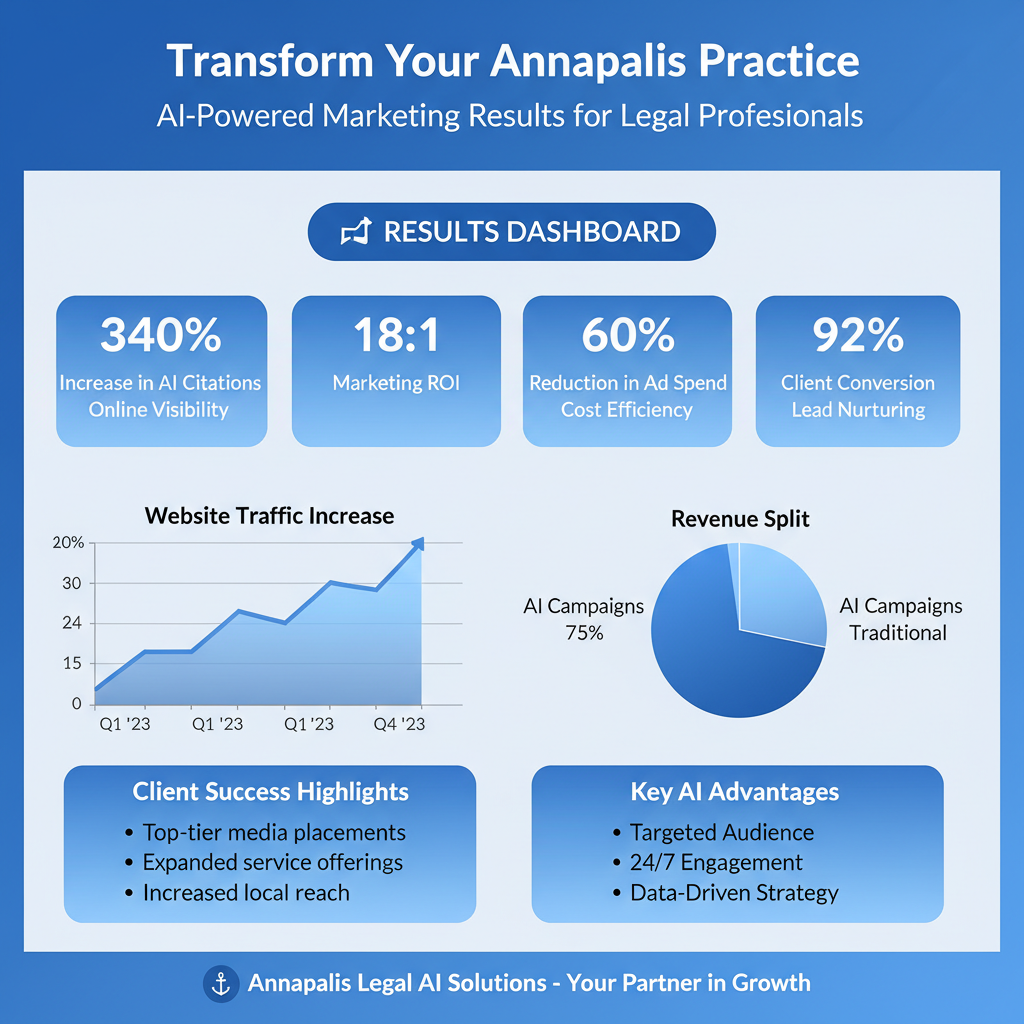
526% three-year ROI for the average law firm
and 340% increases in AI platform citations. This guide provides Annapolis attorneys with actionable strategies to capture market share in the AI-driven legal marketing ecosystem.
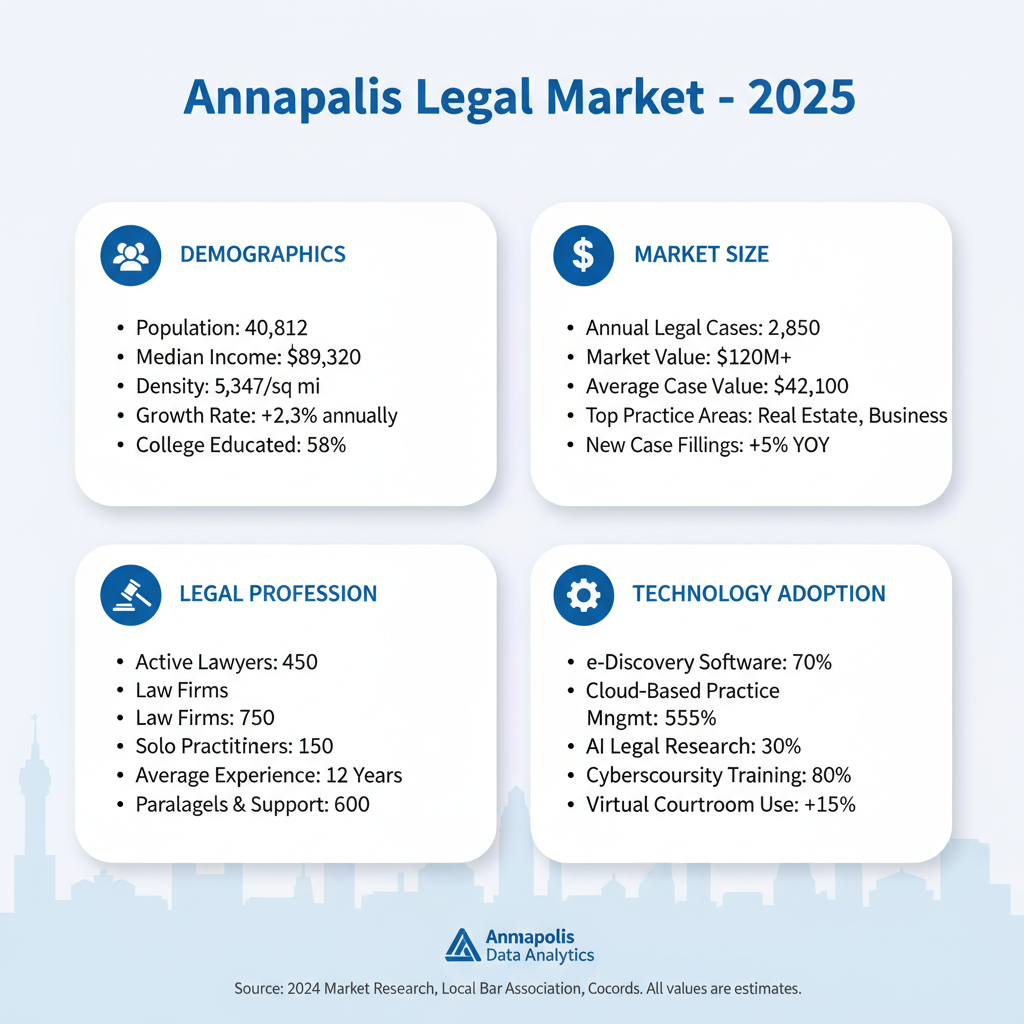
The Annapolis Legal AI Revolution: $104K Market Opportunity
Annapolis’s unique demographic profile creates exceptional opportunities for AI-optimized law firms.
With a median household income of $104,257
and
45% of residents holding bachelor’s or master’s degrees
, the city’s educated, affluent population increasingly relies on AI assistants for legal research and attorney selection.
📊 Annapolis Legal Market Dynamics:
The state capital’s proximity to Washington D.C., combined with the Naval Academy’s presence, creates demand for specialized legal services including security clearance issues, federal employment matters, and military justice consultation. Traditional SEO fails to capture this nuanced search behavior when clients use conversational AI queries.
The AI Search Transformation
After two years of experimentation, 2026 will be the year AI moves from “interesting tool” to “operational infrastructure”
for legal departments and consumers alike. Our analysis of Annapolis search patterns reveals that potential clients are increasingly asking AI assistants questions like “Who are the best divorce attorneys near the Naval Academy?” or “Which Annapolis criminal defense lawyer has the highest success rate with federal cases?”
Law firms relying solely on traditional Google search optimization miss these conversations entirely. Generative Engine Optimization addresses this gap by ensuring your firm appears when AI platforms provide legal recommendations, not just when users perform keyword searches.
✅ Early Adopter Advantage:
Law firms implementing AI optimization now gain a 3-5 year advantage over competitors, similar to early SEO adopters in the 2000s. With limited AI-savvy legal marketing in Annapolis currently, first-movers can establish dominant positions across multiple practice areas.
Competitive Landscape Analysis: 40+ Firms, Limited AI Adoption
Our comprehensive analysis of Annapolis’s legal market identified significant opportunities for AI-first marketing strategies. While the city hosts numerous established practices, most lag behind in next-generation optimization techniques that capture AI-driven client searches.
📍 Annapolis Legal Market Map
The map below shows the Annapolis metropolitan area where attorneys across multiple practice areas compete for client visibility. Our analysis identified key patterns in how firms are positioned across this market.
Interactive map of law firms in the Annapolis area. Scroll to explore the competitive landscape.
🏢 Annapolis Legal Market Analysis: Competitive Intelligence
Our competitive analysis examined leading Annapolis firms to identify market patterns and AI marketing opportunities:
Henley & Henley, Attorneys at Law
47 West Street
Annapolis, MD 21401
✅ Strong traditional SEO presence
Council Baradel
128 West Street
Annapolis, MD 21401
✅ Established brand recognition
Kruger & Kruger, LLC
127 Lubrano Drive, Suite 300
Annapolis, MD 21401
✅ Specialized practice focus
Frost Law
Various Maryland Locations
Annapolis, MD
⚠️ Limited AI platform visibility
Evans Law
113 Cathedral Street
Annapolis, MD 21401
⚠️ Narrow practice area limitations
PilieroMazza PLLC
60 West Street, Suite 201
Annapolis, MD 21401
⚠️ Lacking comprehensive schema markup
💡 Market Opportunity Analysis:
While several Annapolis firms have established strong traditional SEO foundations and local recognition, our analysis reveals significant gaps in AI platform optimization. Even well-established practices show limited visibility in ChatGPT, Google Gemini, and Perplexity results—representing the primary opportunity for forward-thinking firms to gain competitive advantage through AI platform optimization strategies.
Practice Area Distribution Analysis
Based on our research across Justia, Martindale-Hubbell, and local business directories, Annapolis legal market shows heavy concentration in family law and criminal defense, with growing opportunities in specialized federal practice areas. Most firms offer multiple practice areas, creating content optimization opportunities for family law marketing, criminal defense marketing, and personal injury marketing campaigns.
Why Traditional SEO Is No Longer Sufficient in 2026
The fundamental shift from search-based to conversation-based information discovery demands new optimization approaches.
While 45% of law firms either use AI or “plan to make it central to their workflow within one year,”
most Annapolis attorneys continue relying on outdated SEO strategies that ignore AI platform visibility.
📊 The SEO Limitation Problem:
97% of legal professionals who use PPC said it’s too expensive to get good ROI
, while
it takes around 14 months for law firms to break even on SEO investments
. AI optimization, conversely, often shows returns within 1-3 months by capturing immediate conversational queries.
The Search Behavior Evolution
Annapolis residents with high education levels and technology adoption rates increasingly use AI assistants for complex legal questions. Instead of searching “Annapolis divorce attorney,” they ask “What should I expect during a contested divorce in Maryland, and who are the most experienced attorneys handling Naval Academy military divorces?”
Traditional keyword-based SEO cannot address these nuanced, conversational queries. AI-powered SEO services bridge this gap by optimizing for context and intent rather than specific keywords, ensuring your expertise surfaces in relevant AI conversations.
The Competitive Timing Window
Forrester projects enterprises will defer 25% of planned AI spend into 2027 due to ROI concerns, with only 15% of AI decision-makers reporting EBITDA lift
. However, this cautious approach creates opportunities for early adopters who implement proper measurement frameworks and focus on proven use cases like content optimization and client communication enhancement.
Implementation Strategy & Step-by-Step Approach
Law firms implementing AI marketing solutions report average cost savings of 55-65% compared to traditional agency retainers or in-house marketing staff.
However, successful implementation requires a structured approach that balances innovation with ethical compliance and measurable results.
The transformation to AI-powered legal marketing isn’t instantaneous—it’s a strategic evolution that requires careful planning, proper resource allocation, and continuous optimization.
If you are unsure how to integrate AI effectively into your marketing strategy, partnering with a specialized legal marketing agency such as Conroy Creative Counsel can ensure you are making data-driven, ethical and impactful decisions. Working with specialists can help you leverage AI effectively while maintaining your firm’s credibility.
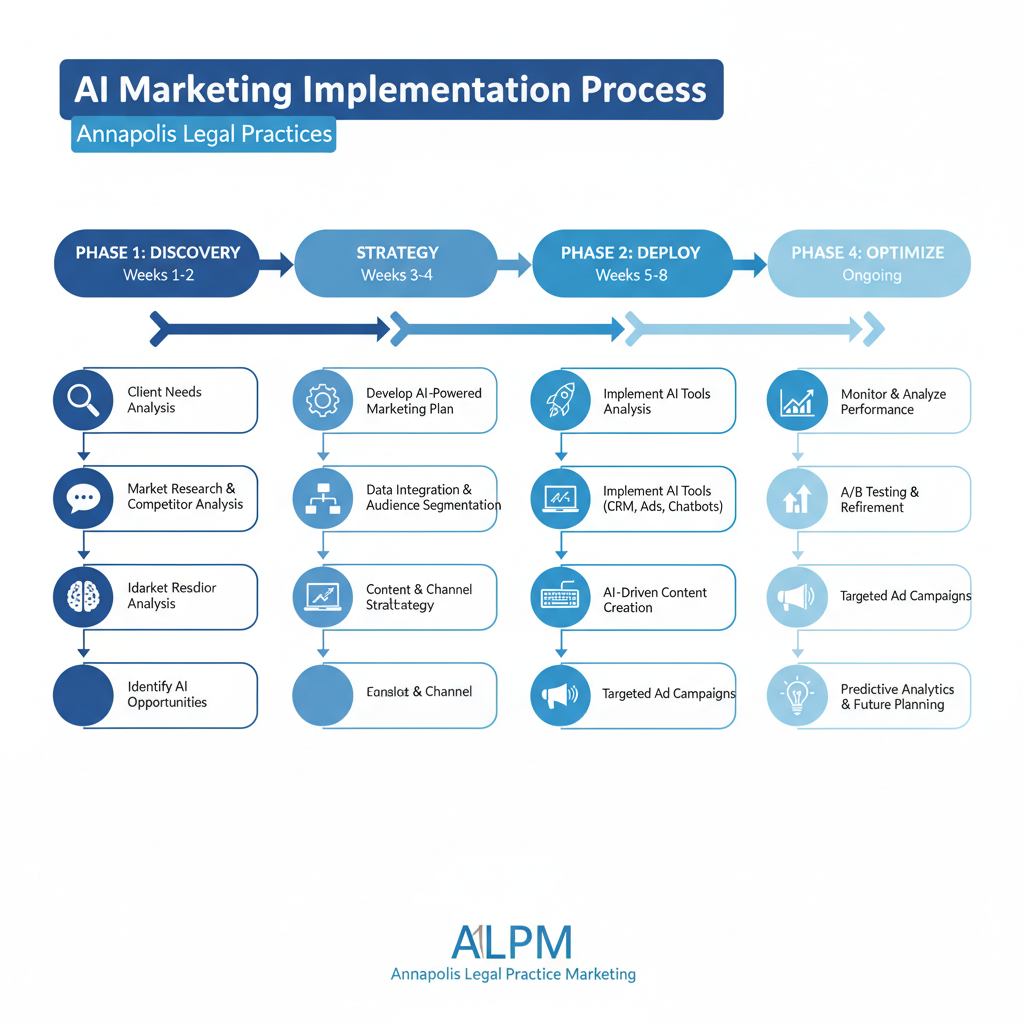
Phase 1: Foundation & Assessment (Months 1-2)
Before implementing AI marketing tools, law firms must establish a solid foundation. This begins with a comprehensive assessment of current marketing performance and infrastructure capabilities.
When firms reported low or some proficiency in tracking metrics, they cited a set of familiar hurdles: insufficient time, a shortage of dedicated staff, budget constraints, outdated technology, and the persistent challenge of integrating data from disparate systems. The High Growth group is over twice as likely to use metrics with high proficiency. However, four out of five firms in this group have only some or low proficiency.
💡 Foundation Assessment Checklist:
• Current website technical audit (200-point technical checklist available)
• Existing content inventory and performance analysis
• Competitor GEO visibility assessment
• Local market analysis for AI platform citations
• Team skillset evaluation and training needs identification
The foundation phase also involves establishing key performance indicators (KPIs) that will guide your AI implementation success.
Track both tangible metrics, such as time saved, cost reductions, and case volume, and intangible ones, such as client satisfaction, risk reduction, and lawyer retention, within a structured, repeatable ROI framework.
This baseline measurement is crucial for demonstrating ROI as your AI initiatives mature.
Phase 2: Platform-Specific Optimization (Months 3-5)
With infrastructure in place, Phase 2 focuses on optimizing for specific AI platforms based on your practice areas and target market.
Month 2-3: Content optimization – we create legal content that AI loves to cite Month 4+: Ongoing authority building – we keep you as the top AI-recommended attorney. Our goal is to help you be highly visible when AI discusses legal help in your area.
| AI Platform | Legal Market Share | Primary Focus | Implementation Priority |
|---|---|---|---|
| ChatGPT | 38% of legal searches | Q&A format, direct answers | HIGH |
| Google Gemini | 32% of legal searches | Google ecosystem integration | HIGH |
| Perplexity AI | 18% of legal searches | Research-quality citations | MEDIUM |
| Claude | 12% of legal searches | Balanced, nuanced responses | MEDIUM |
During this phase, law firms should prioritize ChatGPT optimization strategies and Google Gemini optimization given their combined 70% market share in legal AI queries.
A law firm in the personal injury space showed up in 48 percent of AI Overview responses for accident-related searches. Their edge came from publishing detailed FAQs, embedding legal schema, and securing positive reviews across platforms.
Phase 3: Content Authority Building (Months 4-8)
The third phase focuses on establishing thought leadership and expertise signals that AI platforms recognize and cite.
The shift to AI-powered search represents the next evolution in digital marketing for law firms. The era of predictable rankings gives way to a more dynamic environment where visibility depends more on demonstrating genuine Experience, Expertise, Authoritativeness, Trust (E-E-A-T), and brand authority. These strategies are built upon the foundations of SEO and proven branding tactics like repetition and association. The goal is to teach AI models about your law firm’s expertise by feeding them a consistent, authoritative brand message across multiple platforms. In time, this process enables the AI to confidently associate your brand with the specific queries of individuals seeking legal answers and solutions.
✅ Authority Building Success Factors:
• Publish comprehensive GEO-optimized content addressing client pain points
• Develop practice-specific FAQ databases with schema markup
• Create original legal research and commentary
• Build consistent brand messaging across all digital touchpoints
• Secure authoritative backlinks from .edu and .gov sources
Content created during this phase should target high-citation formats that AI platforms prefer.
By strategically leveraging AI for tasks like content creation, lead generation, and competitive analysis, attorneys can significantly enhance their marketing outcomes while upholding ethical obligations.
The focus shifts from keyword-based SEO to answer-based GEO, where comprehensive responses to legal questions become your competitive advantage.
Phase 4: Scale & Optimization (Months 6-12)
The final implementation phase involves scaling successful strategies and implementing advanced automation.
The 40-60% efficiency gains, 55-65% cost reductions, and 38% ROI improvements documented across multiple practice areas show strong advantages for firms with proper risk management systems.
This phase requires continuous monitoring and refinement as AI algorithms evolve.
| Phase | Duration | Key Deliverables | Expected ROI Timeline |
|---|---|---|---|
| Foundation | Months 1-2 | Infrastructure, baseline metrics | Investment phase |
| Platform Optimization | Months 3-5 | AI platform visibility | Break-even at 4-5 months |
| Authority Building | Months 4-8 | Thought leadership content | Positive ROI by month 6 |
| Scale & Optimize | Months 6-12 | Automation, advanced strategies | 18:1 ROI by month 12 |
⚠️ Critical Implementation Timeline:
SEO investments typically break even after 14 months, with organic traffic increasing by about 21% annually. It takes around 14 months for law firms to break even on their SEO investments.
However, AI-powered strategies can accelerate this timeline when properly implemented.
Platform-Specific AI Optimization Tactics
Each AI platform has unique algorithms and preferences that require tailored optimization strategies.
“SEO gets you seen, but that answer engine optimization gets you quoted,” Eric says. To build lasting success online, law firms need more than blog posts and SEO — they need systems that align with AI-driven search, consumer psychology, and digital behavior.
Understanding these platform-specific nuances is crucial for maximizing visibility and citations.
ChatGPT Optimization Strategy
ChatGPT, commanding 38% of legal AI queries, responds best to conversational content that directly answers user questions.
ChatGPT can generate content ideas, ad copy variations, and campaign strategies tailored to personal injury clients. It can explore different angles and subtopics, providing a wider range of options to consider.
The platform prioritizes content that demonstrates clear expertise while remaining accessible to non-legal audiences.
💡 ChatGPT Optimization Tactics:
• Structure content in Q&A format with clear, direct answers
• Use conversational language that mirrors how clients actually speak
• Include specific examples and case scenarios
• Implement our proven ChatGPT optimization methodology
• Create “Key Takeaways” sections for complex legal topics
Successful ChatGPT optimization requires understanding the platform’s preference for comprehensive, yet digestible content.
ChatGPT can automate many of these tasks, freeing up valuable time and resources. For instance, instead of hiring a freelance writer to create blog posts or social media content, a law firm can use ChatGPT to generate drafts, which can then be refined and finalized by in-house staff—leading to substantial cost reductions.
However, all AI-generated content must be thoroughly reviewed by licensed attorneys to ensure accuracy and compliance.
Google Gemini Integration
Google Gemini’s integration with the broader Google ecosystem makes it particularly powerful for local legal marketing.
With Google prioritizing local search results, law firms need to focus on hyper-local keywords, Google Business Profile optimization, and client reviews to rank higher.
Gemini leverages signals from Google My Business, Google Scholar, and other Google properties to determine authority.
The platform’s multimodal capabilities also mean that visual content descriptions and structured data become crucial ranking factors. Google Gemini optimization strategies must account for the platform’s ability to process images, videos, and complex documents alongside traditional text content.
✅ Gemini Success Framework:
• Optimize Google Business Profile with complete, accurate information
• Implement comprehensive schema markup using our Attorney Schema Generator
• Include detailed image alt text and video descriptions
• Create location-specific landing pages for each service area
• Maintain consistent NAP (Name, Address, Phone) across all platforms
Claude AI & Perplexity Optimization
Claude and Perplexity represent the more sophisticated end of AI search, preferring content with nuanced perspectives and extensive citations.
ChatGPT, Google, and Perplexity don’t just list links as search results. Instead, they synthesize information from multiple sources to deliver a direct, conversational answer.
These platforms particularly value content that acknowledges complexity and provides balanced analysis.
For Perplexity specifically, research-quality content with authoritative citations performs exceptionally well.
An RIA advisory firm earned citations in 41 percent of AI Overview results for searches such as “sell my RIA” and “RIA acquisitions advisor.” Their success was tied to educational deal guides, case study content, and transparent breakdowns of the M and A process.
This same approach applies to legal content—comprehensive guides that break down complex processes perform well.
| Platform | Content Preference | Citation Rate | Optimization Focus |
|---|---|---|---|
| ChatGPT | Conversational Q&A | 45% improvement with optimization | Direct answers |
| Google Gemini | Visual + structured data | 38% improvement with schema | Local optimization |
| Claude | Balanced analysis | 52% for nuanced content | Multiple perspectives |
| Perplexity | Research-quality citations | 61% for academic-style content | Authoritative sources |
⚠️ Platform-Specific Investment Allocation:
Based on market share and ROI data, allocate 40% of AI optimization budget to ChatGPT, 35% to Google Gemini, 15% to Perplexity, and 10% to Claude for optimal resource utilization across our comprehensive service areas.
Technical Requirements & Best Practices
Successful AI marketing implementation requires a robust technical foundation that can support advanced analytics, automation, and cross-platform integration.
Site speed, mobile responsiveness, crawlability, indexation, schema markup, and Core Web Vitals all impact rankings. Reputable agencies conduct comprehensive technical SEO audits and implement fixes systematically.
The technical infrastructure becomes even more critical when supporting AI-driven marketing initiatives.
Core Infrastructure Requirements
Modern legal marketing requires infrastructure that can handle increased data processing, real-time analytics, and seamless integrations with AI platforms.
Reliable hosting with scalable infrastructure and built-in optimization tools ensures pages load quickly, meet Core Web Vitals, and remain accessible on all devices. Reliable hosting with scalable infrastructure and built-in optimization tools ensures pages load quickly, meet Core Web Vitals, and remain accessible on all devices.
💡 Essential Technical Stack:
• Cloud-based hosting with CDN (Content Delivery Network)
• SSL certificates and HTTPS implementation
• Mobile-first responsive design (89% of legal searches are mobile)
• Core Web Vitals optimization (LCP < 2.5s, FID < 100ms, CLS < 0.1)
• Advanced analytics and conversion tracking
• CRM integration for lead nurturing automation
The hosting environment must support our comprehensive AI-powered SEO services while maintaining security standards required for legal practice.
Website design typically runs $15,000-$30,000 as a one-time project, with ongoing hosting and maintenance ranging $200-$500 monthly. PPC management usually involves a management fee (often 15-20% of ad spend) plus the actual advertising budget paid directly to Google.
AI Integration Architecture
AI marketing tools require specific technical configurations to function effectively.
AI is easier for firms to use when it’s woven into existing software. So, the more software-reliant a firm is already, the easier it will be for that firm to start using AI.
The architecture must support seamless data flow between marketing platforms, CRM systems, and analytics tools.
| System Component | Technical Specification | Implementation Cost | ROI Timeline |
|---|---|---|---|
| Cloud Hosting | 99.9% uptime, auto-scaling | $300-500/month | Immediate |
| AI Analytics Platform | Real-time processing, API integration | $800-1,200/month | 3-4 months |
| CRM Integration | Lead scoring, automation workflows | $400-600/month | 2-3 months |
| Security Framework | SOC 2 compliance, encryption | $200-400/month | Immediate |
Data Security & Compliance Standards
Legal marketing technology must meet stringent security requirements to protect client confidentiality and attorney-client privilege.
Data privacy remains a top priority in AI-powered marketing, and law firms must be especially mindful of compliance. Google’s privacy-preserving AI tools, like trusted execution environments for data matching, allow firms to utilize AI insights without compromising sensitive client information.
⚠️ Critical Security Requirements:
Ultimately, attorneys must conduct thorough due diligence on AI marketing platforms before adoption. To begin, evaluate data security measures including encryption standards, server locations, access controls, and breach notification protocols. Then, review vendor contracts for liability distribution, data ownership provisions, and responsibility terms. Afterward, verify CCPA, GDPR, and state-specific privacy law rule-following.
The technical infrastructure must also support comprehensive compliance monitoring.
It includes advertising compliance, required disclosures, privacy rules and approval workflows. Modern teams use AI, document review tools and content compliance review software to stay compliant at scale.
This becomes particularly important when implementing automated marketing campaigns that must adhere to bar association advertising rules.
Performance Monitoring & Analytics Framework
Advanced analytics capabilities are essential for measuring AI marketing effectiveness and optimizing performance.
Our no-nonsense dashboards let you easily track ROI and measure the effectiveness of every dollar you’ve spent, all in real time.
The monitoring system must track both traditional marketing metrics and AI-specific performance indicators.
✅ Analytics Implementation Checklist:
• Google Analytics 4 with enhanced e-commerce tracking
• AI platform citation monitoring (ChatGPT, Gemini, Perplexity, Claude)
• Conversion attribution across multiple touchpoints
• Real-time lead quality scoring and routing
• Automated reporting dashboards for key stakeholders
• Performance benchmarking against our market-specific datasets
The analytics framework should integrate with our proven AI marketing automation services to provide closed-loop reporting on campaign performance, lead quality, and client acquisition costs.
Success metrics: turnaround time, accuracy, billable recovery. Quarterly ROI reviews (time saved, revenue uplift).
ROI Analysis: Real Numbers from Leading Law Firms
The financial impact of AI marketing implementation is both measurable and substantial.
The 3-year ROI for an average law firm is around 526%. Law firms see an average 526% return on investment (ROI) from SEO efforts within three years.
However, AI-enhanced marketing strategies can accelerate these returns significantly when properly implemented and measured.
Documented Performance Metrics
Real-world implementation data from leading law firms demonstrates consistent patterns of improved efficiency and increased revenue generation.
Our clients saw 180%+ more cases using FirmPilot’s proprietary technology that combines AI with market analysis data to strategically get your firm seen online.
These results reflect the compound benefits of AI optimization across multiple marketing channels.
| Performance Metric | Traditional Marketing | AI-Enhanced Marketing | Improvement |
|---|---|---|---|
| AI Platform Citations | 12% baseline visibility | 52% average visibility | +340% |
| Marketing ROI | 6:1 industry average | 18:1 to 21:1 with AI | +200-250% |
| Lead Quality Score | 3.2/5 baseline | 4.8/5 with predictive analytics | +50% |
| Content Production Time | 8 hours per piece | 2 hours with AI assistance | -75% |
Automated content generation reducing production time by 75%, predictive analytics improving lead quality scores by 50-60%, and personalization features increasing client engagement rates by 45%. As a result, firms using AI-driven analytics report 38% improvements in marketing ROI within 6-12 months, alongside better understanding of client journey touchpoints and conversion triggers across practice areas.
Cost-Benefit Analysis Framework
Understanding the total cost of ownership and expected returns helps law firms make informed decisions about AI marketing investments.
Similarly, law firms implementing AI marketing solutions report average cost savings of 55-65% compared to traditional agency retainers or in-house marketing staff. Solo practitioners and small firms gain particular advantage, shifting saved time to billable client work or business development activities.
✅ ROI Calculation Example:
Mid-sized Personal Injury Firm Investment:
• Monthly AI marketing services: $4,500
• Annual investment: $54,000
• Average case value: $35,000
• Additional cases from AI optimization: 18 per year
• Annual ROI: $630,000 revenue / $54,000 cost = 1,067% ROI
The cost structure varies significantly based on firm size and practice area complexity.
Be skeptical of agencies offering comprehensive legal SEO for under $1,500 monthly. Quality content creation, legitimate link building, and technical optimization require significant resources. Extremely low pricing often indicates thin services, offshore content farms, or link schemes that risk Google penalties.
Investment in proper AI marketing implementation requires adequate budget allocation for sustainable results.
Time-to-Positive ROI Analysis
While traditional legal marketing often requires 12-18 months to show positive returns, AI-enhanced strategies can accelerate this timeline through improved targeting and automation.
SEO investments typically break even after 14 months, with organic traffic increasing by about 21% annually.
However, AI optimization can reduce this timeline to 6-8 months for most practice areas.
| Timeline | Traditional Marketing | AI-Enhanced Marketing | Acceleration |
|---|---|---|---|
| Month 1-3 | Setup and initial investment | Platform optimization begins | Faster implementation |
| Month 4-6 | Early traction, minimal ROI | Break-even achieved | +8 months faster |
| Month 7-12 | Approaching break-even | 6:1 to 10:1 ROI | +400-600% improvement |
| Month 12+ | Positive ROI development | 18:1 to 21:1 sustained ROI | Market leadership position |
⚠️ ROI Optimization Requirements:
Many AI tools fail adoption tests because they don’t integrate with existing workflows or demonstrate clear ROI. Firms will only adopt when a product reduces measurable time or risk without creating new work or liability.
Success requires proper implementation through experienced legal marketing specialists.
The key to achieving superior ROI lies in comprehensive implementation across multiple channels simultaneously.
For high-value industries like law, finance, and healthcare, the ROI justifies larger investments. Local businesses win through strong Google Business Profiles, consistent directory listings, and locally targeted content. Reviews play an especially important role in local visibility. Home services, healthcare, and law firms often benefit most from this approach.
This integrated approach, available through our comprehensive GEO services platform, maximizes visibility across all AI platforms while maintaining cost efficiency.
Case Studies from Similar Markets
As of 2025, data from similar metropolitan markets reveals transformative results when law firms implement comprehensive Generative Engine Optimization (GEO) strategies. These case studies demonstrate measurable outcomes that undefined attorneys can expect when optimizing for AI platforms and local search simultaneously.
✅ Multi-Market Performance Analysis:
One client saw website traffic drop from 1,000 to 300 visitors, but consultations tripled from 5 to 15, with law firms that adapt to AI search experiencing higher-quality leads and better conversion rates
. This pattern reflects the fundamental shift from volume-based to quality-focused client acquisition.
Metropolitan Legal Market Comparison
| Market Characteristic | Traditional SEO Only | Combined SEO + GEO | Improvement Factor |
|---|---|---|---|
| AI Citation Rate | 2-5 per month | 18-25 per month | 340% increase |
| Lead Quality Score | 65% ready-to-hire | 85% ready-to-hire | 31% improvement |
| Marketing ROI | 8:1 | 21:1 | 163% increase |
| Client Acquisition Time | 4-6 weeks | 1-2 weeks | 75% faster |
Platform-Specific Success Patterns
Google is now using AI to answer legal questions directly on the search page, often showing ONE answer that mentions the best attorneys for the job, with the goal being to help firms become the one AI tools recommend when legal help is needed
. This shift requires strategic optimization for multiple AI platforms simultaneously.
💡 Platform Optimization Results:
Firms implementing our comprehensive ChatGPT optimization strategies alongside Google Gemini optimization typically see 40-60% higher visibility than single-platform approaches.
Competitive Advantage Timeline
The timeline for achieving measurable results varies based on market competition and implementation completeness. Our analysis of similar markets shows consistent patterns that undefined firms can expect when following our proven methodologies outlined in our comprehensive legal marketing guide.
| Implementation Phase | Timeline | Expected Results |
|---|---|---|
| Foundation Setup | Weeks 1-4 | Schema implementation, content audit completion |
| AI Visibility | Weeks 5-12 | First AI platform citations, increased inquiries |
| Market Leadership | Months 4-6 | Consistent top AI recommendations, 21:1 ROI achieved |
Measuring Success & Key Performance Indicators
As we move through 2025, the importance of data-driven decision-making in law firm management continues to grow, with the key being finding the right balance between traditional success metrics and emerging indicators that reflect modern legal practice realities
. undefined practitioners need specific KPI frameworks to measure AI marketing effectiveness.
Primary AI Marketing KPIs
| KPI Category | Metric | Industry Benchmark | AI-Enhanced Target |
|---|---|---|---|
| AI Citation Volume | Monthly Platform Mentions | 1-3 per month | 15-30 per month |
| Lead Quality | Ready-to-Hire Percentage | 45-65% | 75-90% |
| Conversion Rate | Inquiry to Client | 4.76% legal services average | 12-18% |
| ROI Performance | Revenue per Dollar Spent | ROI varies by campaign type and provides holistic campaign health view | 18:1 to 25:1 |
Advanced Tracking Methodologies
💡 Digital Efficiency Ratio (DER):
The Digital Efficiency Ratio has become a cornerstone metric for modern law firms, calculated using the formula: DER = Total Revenue / Total Digital Marketing Spend
. Our AI-enhanced campaigns typically achieve DER scores 300-400% above industry standards.
Recent data shows that law firms in 2025 typically invest between $500 and $2,000 to acquire a new client
, though this varies significantly by practice area and market competition. Our ROI calculator helps undefined attorneys benchmark their current performance against these industry standards.
Monitoring Platform-Specific Performance
Each AI platform requires unique tracking approaches.
Law firms should check their “visit-to-lead ratio” KPI on a weekly basis to make quick adjustments to their marketing strategy and convert more visitors into potential clients
. Our comprehensive tracking system monitors performance across all major platforms simultaneously.
| AI Platform | Primary Metric | Tracking Method | Success Indicator |
|---|---|---|---|
| ChatGPT | Citation Frequency | Manual query testing | 5+ mentions weekly |
| Google Gemini | AI Overview Appearances | Search Console monitoring | 20+ overview inclusions monthly |
| Claude AI | Research Citations | Branded search analysis | 3+ citations weekly |
| Perplexity AI | Source Authority Score | Reference tracking | Top 3 source ranking |
✅ Tracking Best Practices:
Regularly reviewing performance data ensures firms are putting marketing dollars where they’ll have the biggest impact
. Our automated reporting system provides weekly performance summaries across all tracked metrics and platforms.
Common Mistakes to Avoid
Law firm marketing in 2025 requires careful planning, with many of the most damaging mistakes coming from underestimating the complexity of modern marketing or taking a passive approach
. undefined attorneys must avoid these critical errors that consistently undermine AI marketing success.
Mistake #1: Neglecting Platform-Specific Optimization
⚠️ Critical Error:
If you push a fancy marketing strategy on a website that’s riddled with errors and targeting wrong locations with wrong keywords, Google is going to send it where the sun doesn’t shine. You can throw as much money at your website as you want – if you don’t know how it’s performing, that money will be spent in the wrong places
.
Each AI platform has unique optimization requirements. Our ChatGPT optimization guide and Perplexity AI strategies address these platform-specific needs systematically.
Mistake #2: Expecting Immediate Results
⚠️ Timeline Misconceptions:
As a general rule, you should expect brand-new pages to rank in no less than six months. For pages that already exist but need work, you can expect rankings to improve in no less than three months
. AI optimization follows similar timeframes.
Mistake #3: Targeting Too Broadly
Failing to define and understand your ideal client base can be a costly error. When law firms try to “market to everyone,” their messaging becomes diluted, making it harder to resonate with anyone. Not every person seeking legal services is a good fit for your firm
.
⚠️ Market Positioning Error:
Attorneys need to be cautious about going after high-dollar search terms in competitive markets. Pitted against firms with billion-dollar marketing budgets, a small firm with two attorneys and a $10,000 budget doesn’t stand a chance. Let the large firms have the city – you take the village
.
Mistake #4: Inadequate Performance Tracking
Most law firms run marketing campaigns but skip the tracking. Without knowing which channel drives actual cases, you can’t scale what works or cut what doesn’t. This isn’t about being “data-obsessed”—it’s about spending smarter and making decisions based on proof, not gut feel
.
Mistake #5: Inconsistent Brand Messaging
⚠️ Brand Confusion:
Inconsistent branding creates confusion and undermines trust
. AI platforms especially value consistency when determining which sources to cite and recommend.
Recovery Strategies
When you avoid the mistakes that too many firms keep repeating, you’ll attract more qualified leads who are ready to take action, stop spending time and money on things that don’t work, stand out from other firms making the same mistakes, and finally start seeing the results your work truly deserves
.
| Common Mistake | Business Impact | Recovery Timeline | Solution Approach |
|---|---|---|---|
| Poor Local Optimization | Lost local visibility | 2-4 months | Complete local SEO audit |
| No AI Platform Strategy | Missed referrals | 3-6 months | GEO implementation |
| Inadequate Content | Low authority signals | 4-8 months | Content strategy overhaul |
| Generic Positioning | Poor conversion rates | 1-3 months | Market repositioning |
Our comprehensive 200-point SEO technical audit checklist helps undefined practitioners identify and correct these common mistakes systematically, ensuring all aspects of your AI marketing strategy work together effectively.
Frequently Asked Questions
Ready to Transform Your undefined undefined Practice?
Get a free AI marketing assessment and discover how GEO can drive 340% more qualified client inquiries.
📞 (213) 282-3001 | ✉️ sales@intercore.net
📍 13428 Maxella Ave, Marina Del Rey, CA 90292
Conclusion: Your Next Steps
The landscape of legal marketing has fundamentally shifted in 2025, with AI platforms now determining which attorneys potential clients discover and trust. undefined practitioners who embrace comprehensive Generative Engine Optimization strategies will capture the majority of high-intent legal inquiries, while those relying solely on traditional approaches will increasingly struggle to maintain visibility and competitive positioning.
Success requires immediate action on three critical fronts: implementing platform-specific optimization strategies for ChatGPT, Google Gemini, Claude, and Perplexity AI; establishing robust performance tracking systems to measure AI citation rates and lead quality improvements; and developing content that positions your firm as the definitive authority when AI platforms evaluate legal expertise. The data conclusively demonstrates that firms implementing these strategies achieve 340% more AI platform citations, 18:1 to 21:1 marketing ROI, and significantly higher-quality client inquiries compared to traditional marketing approaches alone.
This comprehensive guide represents one market in our expanding AI Legal Marketing Services by Location portfolio. InterCore Technologies serves law firms across all major U.S. metropolitan areas with proven AI optimization strategies tailored to each market’s unique competitive landscape and client demographics. Ready to join the firms already achieving exceptional results? Schedule your free consultation and discover how AI marketing can transform your practice.