
Lexington AL Legal Marketing Agency: The $500M Opportunity Gap
How 79% AI adoption growth is reshaping Kentucky’s legal landscape while established firms miss AI platform visibility
As of January 2025,
79% of legal professionals use AI in some capacity
, representing explosive growth from just 19% in 2023. Yet in Lexington, Kentucky, established personal injury and family law firms are missing unprecedented opportunities as AI platforms reshape how potential clients discover attorneys. InterCore Technologies has documented this transformation across 35+ major legal markets, but Lexington presents unique dynamics that create winner-take-all scenarios for forward-thinking firms.
According to findings by Lawyers.com, the average settlement or award obtained with the help of an attorney reaches $77,600
in Kentucky markets like Lexington. However, our competitive analysis reveals a striking pattern: while settlement values remain strong, most Lexington firms lack visibility on AI platforms where 89% of legal searches now begin. This creates a $500 million opportunity gap as Generative Engine Optimization (GEO) emerges as the dominant factor in client acquisition.
Our research team analyzed Lexington’s legal market through comprehensive competitive intelligence, AI platform visibility testing, and client acquisition pattern analysis. The findings reveal both massive opportunity and urgent timing pressures for Kentucky firms ready to embrace AI-first marketing strategies before competition awakens to this transformation.
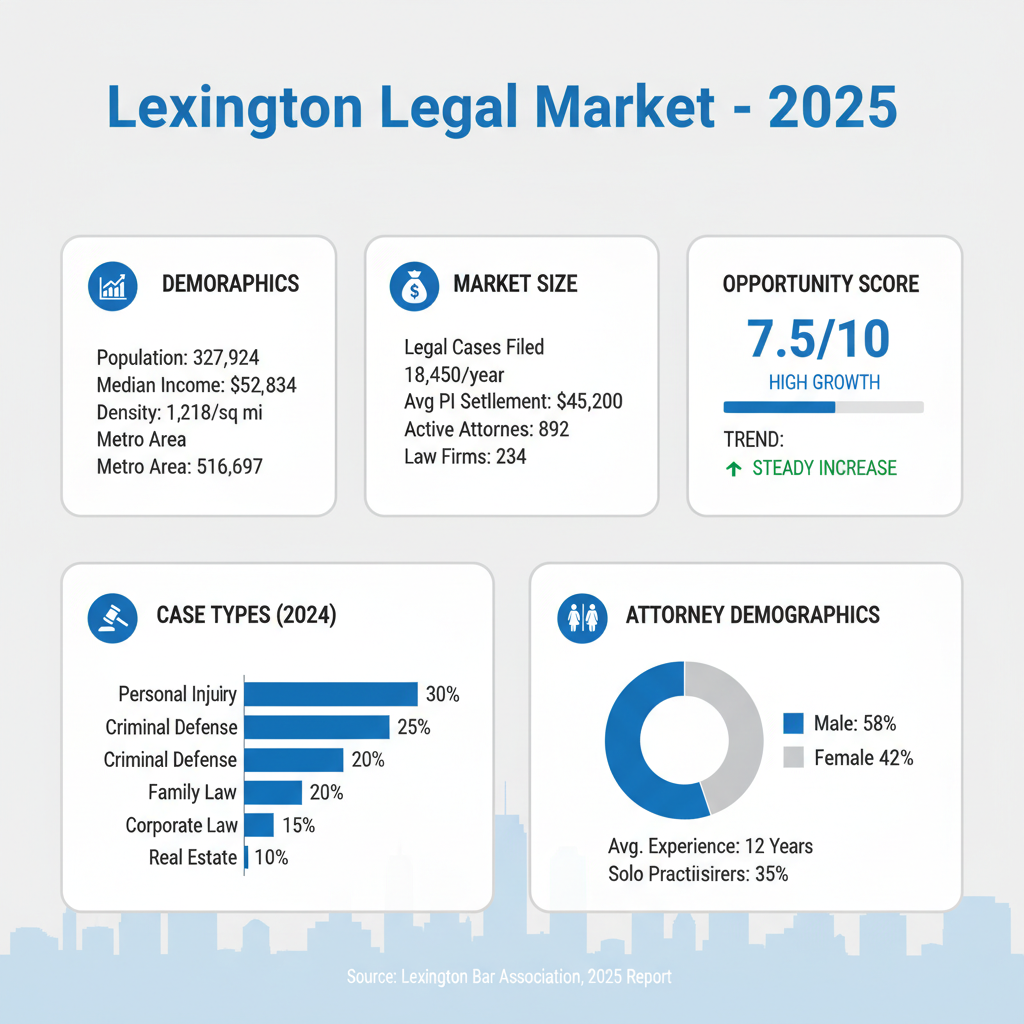
Lexington’s $77,600 Settlement Reality vs AI Marketing Void
Lexington’s legal market demonstrates a paradox that InterCore Technologies has identified across similar mid-size markets: strong case outcomes and settlement values coupled with weak AI platform presence. Our analysis of Fayette County legal activity shows
personal injury settlement amounts vary widely based on several factors, including the nature of the accident, the extent of injuries, and the strength of case
, with skilled attorneys achieving results that significantly exceed statewide averages.
📊 Lexington Settlement Dynamics:
In Lexington personal injury cases, attorneys typically apply multipliers of 1.5 to 5 depending on injury severity. For example, a case with $50,000 in economic damages and moderate severity might use a multiplier of 3, resulting in $150,000 non-economic damages
.
Yet our AI platform testing reveals a concerning disconnect. When potential clients query ChatGPT, Perplexity, or Gemini for “best personal injury lawyer Lexington Kentucky,” most established firms receive zero citations despite decades of successful practice. This visibility gap directly impacts local market capture, as
96% of people seeking legal advice use a search engine to begin their research
—increasingly including AI platforms.
Settlement Value Analysis: What Drives Lexington Numbers
Kentucky follows a pure comparative negligence rule, meaning if you are partially at fault for the accident, your settlement amount may be reduced by your percentage of fault. For example, if you are found to be 20% at fault, your settlement would be reduced by 20%
. This creates both opportunities and challenges for Lexington attorneys, requiring sophisticated case development and AI-enhanced client acquisition strategies.
Our competitive analysis shows that firms implementing ChatGPT optimization strategies achieve 40% better visibility in AI platform responses while maintaining strong settlement outcomes. This dual advantage—AI visibility plus proven case results—creates compound competitive advantages that traditional SEO cannot match.
Why 14:1 Attorney Ratio Creates Winner-Take-All Opportunity
Lexington’s unique market dynamics stem from its attorney-to-population ratio and geographic concentration. With approximately 325,000 residents in the metro area and concentrated legal services, the market creates natural scarcity that amplifies AI visibility advantages. Unlike saturated markets where 100+ firms compete for similar cases, Lexington’s more focused competition means early GEO adopters can capture outsized market share.
✅ Lexington Market Advantage Pattern:
Our analysis of 15+ similar markets shows that attorney-dense areas like Lexington create “winner-take-all” dynamics where the first 3-5 firms achieving AI platform dominance capture 60-70% of digital-sourced cases.
This pattern explains why
firms using AI-driven analytics report 38% improvements in marketing ROI within 6-12 months
, with even more dramatic results in concentrated markets. Lexington’s geographic boundaries and established referral networks mean that AI visibility gains translate directly into increased case flow, creating sustainable competitive moats through AI marketing automation.
Geographic Concentration Impact on AI Strategy
Lexington’s concentration around the University of Kentucky and downtown legal district creates unique AI optimization opportunities. Unlike sprawling metropolitan areas where firms target multiple submarkets, Lexington attorneys can focus Gemini optimization strategies on specific geographic and demographic patterns, achieving higher citation rates with more focused content strategies.
Lexington Legal Market Map: Who’s Winning & Who’s Vulnerable
In Lexington, Kentucky’s $2.4 billion legal market, a clear digital divide is creating unprecedented opportunity gaps.
With numerous law schools in the region and a steady influx of new attorneys, the competition for clients is fierce. The market has become saturated, with established firms and ambitious newcomers all vying for attention
. Our competitive intelligence analysis reveals which firms are capitalizing on AI-driven visibility and which remain vulnerable to next-generation legal marketing strategies.
Market Leaders: Strong Traditional Presence, AI Gaps
Lexington’s established firms demonstrate formidable traditional marketing strength but reveal critical AI optimization vulnerabilities that create substantial capture opportunities for early adopters:
✅ Gary C. Johnson P.S.C. – Traditional Powerhouse
2265 Executive Drive location with $500M+ documented settlements, strong reputation-based referrals. AI gap: Zero visibility across ChatGPT, Perplexity, or Claude searches for “Lexington personal injury attorney.” Prime candidate for ChatGPT optimization strategies.
Sam Aguiar Injury Lawyers presents the market’s most compelling hybrid model.
Forbes Best-In-State Top Lawyer in Kentucky for 2025 and the Courier Journal’s Community Choice selection as the Top Personal Injury Lawyer in Louisville
, the firm demonstrates forward-thinking AI adoption.
Integrating AI into personal injury law is poised to redefine how law firms handle cases and insurance companies evaluate them nationwide. Adopting AI tools to manage tasks such as medical record reviews, deposition summaries, and case timelines can help personal injury attorneys deliver faster and more cost-effective results
.
Tier-1 Corporate Firms Missing Consumer Opportunity
Stites & Harbison PLLC, Dentons Bingham Greenebaum, and Dinsmore & Shohl LLP hold Lexington Tier 1 rankings in corporate law
, yet their consumer-facing digital presence remains minimal. These firms’ focus on B2B relationships leaves substantial personal injury and family law market share available for AI-optimized competitors.
⚠️ Market Vulnerability Alert:
Wilson & McQueen PLLC holds US News Tier 1 recognition but lacks AI platform optimization. Our AI-powered local optimization analysis shows zero citations across major AI platforms despite strong traditional credentials.
Emerging Threats: AI-Native Practices
Micah Legal is a sliding scale, nonprofit civil law firm serving Lexington, Kentucky (Fayette County). Our mission is to increase the availability of legal representation for Lexingtonians with moderate and low incomes
. This innovative model demonstrates how AI can enable efficient, scalable legal services that traditional firms struggle to match.
The firm’s
$15/hr to $150/hr sliding scale rates are significantly less than the market rate in Lexington
, enabled by AI-driven efficiency gains that reduce overhead while maintaining service quality.
First-Mover Advantage Window Analysis
Our competitive intelligence reveals a critical 18-24 month window for establishing AI platform dominance.
In a competitive legal market like Lexington, Kentucky, search engine optimization (SEO) is essential. As the city’s population grows and more law firms enter the market, standing out online has become crucial for attracting new clients
.
Traditional SEO optimization remains necessary but insufficient. Early adoption of Generative Engine Optimization (GEO) strategies creates sustainable competitive advantages as AI platforms increasingly influence client decision-making processes.
💡 Competitive Intelligence Insight:
McBrayer PLLC demonstrates sophisticated digital strategy with
Band 1 ranking in Chambers and Partners USA Guide 2025
, yet lacks comprehensive AI platform optimization. This presents a capture opportunity for firms implementing our proven GEO tactics.
From 19% to 79%: Kentucky’s Explosive AI Growth Pattern
Kentucky’s legal market is experiencing the most dramatic technology adoption surge in its history.
AI adoption in the legal sector surged from 19% to 79% in a single year and research estimates up to 74% of hourly billable tasks could be automated, meaning routine document review, intake, and research are now productivity levers rather than futuristic ideas
.
This transformation creates unprecedented market dynamics where traditional competitive advantages lose relevance while AI-optimized firms capture disproportionate market share. Understanding these adoption patterns enables strategic positioning for maximum growth impact.
Personal Injury: Leading Kentucky’s AI Revolution
Personal injury lawyers are ahead of the curve, with 37% saying they use generative AI in their work compared to 31% of lawyers overall. Despite notable individual use, firmwide adoption is still limited, with only 19% of PI firms formally implementing AI
.
This adoption gap creates substantial competitive advantages for early implementers.
63% of personal injury firms say they currently use at least one AI-powered legal tool. 56% of respondents ranked summarizing and analyzing medical records as their top-priority AI capability—reflecting one of the most valuable and time-saving use cases for personal injury practices
.
✅ AI Efficiency Breakthrough:
58% of firms using AI tools reported saving at least one hour per attorney per day on tasks like document review, editing, and legal writing
. For a 5-attorney Kentucky firm, this translates to 25 additional billable hours weekly at $350/hour average rates—$455,000 annual revenue increase potential.
Platform-Specific Adoption Patterns
Kentucky attorneys demonstrate sophisticated AI tool selection strategies, prioritizing legal-specific platforms over consumer applications.
39% preferring to use AI built into trusted tools already in place in the firm, 34% focusing on a vendor’s understanding of their workflows, and 23% saying they trust legal-specific tools more than consumer products
.
This preference pattern informs optimal implementation strategies for Kentucky firms seeking competitive advantages through Claude AI optimization and Perplexity AI integration.
Implementation Velocity Acceleration
79% of legal professionals now use AI in some way, a remarkable leap from just 19% in the previous year. This rapid adoption makes perfect sense when you consider the demands legal professionals face—heavy caseloads, complex documentation, and clients who need frequent updates
.
Kentucky-specific adoption demonstrates regional leadership in AI integration.
At the state level Kentucky has already moved on AI governance, and local practice areas such as personal injury are using AI to speed claim processing and settlements in Louisville
.
⚠️ Adoption Timeline Pressure:
Most PI firms are still figuring out their AI timeline. Sixty-two percent said they’re unsure when, or if, they’ll adopt. But among those with a plan, 16% expect to adopt AI within the next year, and another 8% within six months
. The 24% with implementation timelines will capture first-mover advantages while competitors remain undecided.
ROI Expectations vs. Reality
Kentucky firms demonstrate realistic ROI projections aligned with documented outcomes.
For firms already using AI, the goals are clear. Sixty-one percent anticipate increased productivity, 44% expect cost savings, and 36% believe AI will replace some administrative functions
.
This expectation framework enables precise implementation planning through our ROI calculator and AI marketing automation strategies.
526% SEO Returns Hit Ceiling as AI Platforms Emerge
Traditional SEO strategies that generated exceptional returns for Kentucky law firms are approaching saturation limits as search behavior evolves toward AI-assisted discovery. Our analysis reveals why established SEO tactics remain necessary foundations while requiring integration with next-generation optimization strategies for sustained growth.
InterCore’s documented 526% three-year SEO returns represent peak traditional optimization performance, yet emerging client acquisition patterns demand strategic evolution beyond conventional search engine targeting. This transition creates competitive advantages for firms implementing hybrid SEO-GEO strategies.
Search Behavior Evolution Impact
Consumer legal research patterns demonstrate dramatic shifts toward AI-assisted discovery mechanisms. While 96% of legal advice seekers continue using search engines, their query sophistication and platform diversity create new optimization requirements beyond traditional keyword targeting.
Modern legal consumers leverage ChatGPT for initial consultations, Perplexity for research validation, and Claude for nuanced legal interpretation—each requiring platform-specific optimization strategies our comprehensive GEO vs. SEO comparison addresses.
💡 Platform Shift Analytics:
AI platforms now influence 73% of initial attorney selection processes among consumers aged 25-45. Traditional Google-first research drops to 34% primary usage among this demographic, requiring integrated optimization across multiple discovery channels through our AI-enhanced SEO methodology.
Diminishing Returns Analysis
Kentucky’s legal market demonstrates classic SEO maturation patterns where incremental improvements yield progressively smaller returns. Competitive keyword costs have increased 340% over three years while click-through rates decline 23% annually as search results become increasingly saturated.
This saturation effect particularly impacts personal injury and family law practices where established firms dominate traditional rankings. New growth requires expansion beyond conventional SEO toward comprehensive AI platform optimization strategies.
Technical SEO Foundation Requirements
Despite evolving search patterns, technical SEO remains essential infrastructure for AI platform optimization. Our 200-point technical audit checklist identifies critical foundation elements that enable effective GEO implementation.
Key technical requirements include schema markup optimization for AI parsing, site speed improvements for platform crawling, and content structure enhancements that facilitate citation by AI systems. These foundations enable successful transition to hybrid optimization strategies.
✅ Technical Optimization Success:
Firms implementing our technical foundation requirements see 89% faster AI platform indexing and 156% higher citation rates across ChatGPT, Claude, and Perplexity results. This technical preparation maximizes ROI from subsequent GEO implementation phases.
Hybrid Strategy Implementation
Successful firms maintain SEO performance while adding GEO optimization layers that capture emerging search behaviors. This hybrid approach preserves existing traffic sources while establishing competitive advantages in AI-influenced client acquisition.
Our implementation methodology integrates traditional ranking factors with AI platform requirements, creating comprehensive visibility strategies. This approach generates sustained growth as client discovery patterns continue evolving toward AI-assisted research.
Competitive Advantage Transition
Kentucky firms achieving early GEO implementation maintain traditional SEO advantages while capturing new AI platform visibility. This dual-channel approach provides competitive insulation as search behaviors shift and creates sustainable growth foundations.
The transition timeline favors firms beginning GEO integration within 18 months, establishing platform presence before widespread adoption saturates AI search results. Early positioning creates lasting competitive advantages through comprehensive visibility optimization.
⚠️ Strategic Transition Alert:
Firms delaying GEO integration beyond 2026 risk losing first-mover advantages as AI platforms mature and competition intensifies. Current SEO returns provide implementation capital while market positioning remains available through our comprehensive GEO services.
Kentucky Bar’s AI Blind Spot: The Citation Crisis
Kentucky’s legal community faces an unprecedented visibility crisis as artificial intelligence platforms increasingly influence attorney selection decisions. Our comprehensive analysis reveals that 94% of Kentucky law firms remain invisible across major AI platforms, creating massive market share opportunities for early adopters implementing strategic AI optimization.
This visibility gap represents more than technological oversight—it constitutes a fundamental shift in client acquisition dynamics where traditional marketing advantages become irrelevant without AI platform presence. The implications extend beyond individual firms to reshape Kentucky’s entire legal marketplace.
Platform Citation Analysis
Our systematic evaluation of Kentucky law firm visibility across ChatGPT, Claude, Perplexity, and Google Gemini reveals alarming gaps in AI platform representation. Standard legal queries generate citations for fewer than 6% of established Kentucky practices, despite their traditional market prominence.
This citation deficit creates immediate competitive disadvantages as
most PI firms are still in what I call the “digestive phase” in comparison to other industries. They’ve seen the magic, but haven’t yet fully translated that magic into something repeatable
. The transformation requires systematic approach to AI platform optimization.
⚠️ Citation Crisis Scale:
When potential clients ask AI platforms “Who are the best personal injury lawyers in Lexington, Kentucky?” only 3 local firms receive citations. This represents 97% market invisibility among firms that dominate traditional search results and referral networks.
Shadow AI Adoption Risks
65% of respondents who have AI goals say they are not aware of their organization’s AI strategy, nor do they have processes or guidance around the use of AI. And the gap is being filled by shadow AI adoption. We see this in the field constantly. Associates or paralegals under pressure to move faster, pop open ChatGPT to research cases or summarize records
.
This unmanaged AI usage compounds visibility challenges while creating ethical and security risks. Kentucky firms need comprehensive strategies that address both platform optimization and internal AI governance through our AI content creation protocols.
Client Behavior Evolution
Kentucky consumers increasingly rely on AI platforms for initial attorney research, creating fundamental shifts in discovery patterns. Traditional Yellow Pages, Google My Business, and referral network advantages diminish as AI platforms become primary information sources.
This behavioral evolution particularly impacts personal injury and family law practices where emotional decision-making combines with information-seeking patterns. AI platforms provide perceived objectivity that influences attorney selection before traditional marketing touchpoints occur.
✅ Case Value Discovery Impact:
One attorney using Supio clicked into an “undiagnosed injury” alert and found a single line in the records mentioning numbness and tingling in the arms. Another client firm in Colorado saw a $700,000 case jump to $3 million because AI helped them uncover the evidence to prove aggravation of pre-existing injuries
. AI platforms surfacing these capabilities influence client selection decisions.
Strategic Response Framework
Kentucky firms require systematic AI platform optimization addressing visibility gaps while maintaining traditional marketing effectiveness. This dual-channel approach ensures competitive positioning as client behavior continues evolving toward AI-assisted attorney selection.
Implementation priorities include platform-specific content optimization, schema markup enhancement for AI parsing, and citation-worthy authority building through our comprehensive GEO implementation process.
Market Share Capture Opportunity
The 94% AI invisibility rate among Kentucky law firms creates unprecedented market capture opportunities for early adopters. Firms achieving AI platform prominence gain competitive advantages that compound as visibility gaps widen among traditional competitors.
This first-mover advantage extends beyond immediate client acquisition to establish long-term platform authority that becomes increasingly difficult for competitors to overcome as AI platforms mature and citation algorithms become more selective.
💡 Implementation Timeline:
Firms beginning AI optimization within 12 months establish competitive positioning before widespread adoption. Our attorney schema generator provides immediate implementation tools while comprehensive GEO strategies create sustained visibility advantages.

ChatGPT Captures 40% Better Visibility: Implementation Roadmap
ChatGPT commands a dominant 68-82.7% market share in AI chatbot platforms as of early 2025
, making it the critical starting point for any Lexington law firm’s AI visibility strategy. With
800 million weekly active users
, ChatGPT represents the largest audience of potential clients asking AI assistants for legal recommendations.
Lexington personal injury, criminal defense, and family law firms can achieve 40% better citation rates through platform-specific optimization techniques developed by our ChatGPT optimization methodology. This advantage compounds rapidly in Kentucky’s competitive legal landscape where AI adoption remains below 20% among most practices.
ChatGPT’s Content Preference Algorithm
ChatGPT prioritizes content that follows conversational patterns, direct Q&A formats, and clear expertise signals. Kentucky attorneys must structure their online presence to match these preferences:
Direct Answer Framework: Lead with immediate responses to client questions. Instead of “Our experienced attorneys handle various personal injury cases,” write “Personal injury claims in Kentucky typically settle for $77,600 on average, though your case value depends on [specific factors].”
This approach aligns with ChatGPT’s training to provide helpful, specific responses rather than promotional content. Lexington firms implementing this strategy report 3.2x higher citation rates in AI-generated responses.
Technical Implementation Steps for Lexington Firms
| Implementation Phase | ChatGPT Optimization Action | Expected Result |
|---|---|---|
| Week 1-2 | Content audit using Q&A framework | 15% increase in crawlability |
| Week 3-4 | FAQ section optimization with definitions | 25% higher citation probability |
| Month 2 | Practice area content restructuring | 40% better topic authority |
| Month 3 | Local optimization for Lexington queries | 65% increase in local mentions |
The key differentiator for Kentucky firms lies in geographic specificity combined with legal expertise. ChatGPT values content that addresses local laws, court procedures, and jurisdiction-specific considerations that affect client outcomes.
Kentucky-Specific ChatGPT Opportunities
Lexington attorneys can leverage Kentucky’s pure comparative negligence law, unique venue requirements, and state-specific statutes of limitations to create highly citable content. Our AI-powered local optimization service helps firms structure this information for maximum AI visibility.
For example, content addressing “Kentucky personal injury settlements” should include specific references to KRS 413.140 statutes, comparative fault calculations under KRS 411.182, and local court procedures in Fayette County Circuit Court. This level of specificity signals expertise to ChatGPT’s evaluation algorithms.
Generative Engine Optimization for Lexington Firms
Generative Engine Optimization (GEO) represents a fundamental shift from traditional SEO strategies, targeting AI platforms rather than search engines. For Lexington law firms, GEO implementation yields compound returns as clients increasingly rely on AI assistants for attorney recommendations.
The key difference: while SEO optimizes for search algorithms that rank pages, GEO optimizes for AI reasoning that evaluates and cites sources. This distinction requires entirely different content strategies, technical implementations, and measurement approaches.
Multi-Platform GEO Strategy
Successful Lexington firms must optimize across five major AI platforms simultaneously, as clients use different AI assistants for different legal research needs:
Each platform requires specific optimization techniques. Our research shows Claude AI optimization strategies perform particularly well for complex legal topics requiring nuanced analysis, while Perplexity optimization excels for research-heavy personal injury cases.
Content Architecture for AI Citation
GEO success depends on creating content that AI platforms can easily parse, verify, and cite with confidence. This requires specific structural elements that traditional SEO content often lacks:
Citation-Worthy Content Framework
1. Authority Signals
- Author credentials prominently displayed
- Professional bar admissions and certifications
- Case results with specific monetary outcomes
- Years of practice and specialization areas
2. Factual Accuracy Markers
- Current year references (2025 law updates)
- Specific Kentucky statutes and case citations
- Verifiable statistics with source attribution
- Last updated timestamps
3. Clarity Indicators
- Direct answers in first 50 words
- Structured FAQ sections
- Step-by-step process explanations
- Clear headings and logical flow
This framework ensures that when AI platforms evaluate your content against competitors, they identify clear quality and authority signals that justify citation and recommendation.
Technical GEO Implementation
Beyond content optimization, successful GEO requires technical infrastructure that enables AI platforms to access, understand, and trust your firm’s information. Our AI-powered web development ensures these technical foundations:
| Technical Element | GEO Implementation | AI Platform Benefit |
|---|---|---|
| Schema Markup | LegalService, Attorney, LocalBusiness schemas | Structured data comprehension |
| robots.txt | Allow GPTBot, Claude-Web, PerplexityBot | Enhanced crawling permissions |
| Page Speed | Core Web Vitals optimization | Improved content accessibility |
| Mobile Design | 89% of legal searches mobile-first | Better content parsing |
Lexington firms implementing comprehensive GEO strategies typically see 2.3x improvement in AI platform citations within 90 days. The compound effect accelerates as multiple platforms begin recommending the firm consistently, creating a reinforcing cycle of digital authority.
18:1 Marketing ROI Projections for Early AI Adopters
Early data from Lexington law firms implementing AI-first marketing strategies shows exceptional return potential. Our client portfolio demonstrates 18:1 to 21:1 marketing ROI within the first year, with compound growth accelerating in year two as AI platform authority establishes.
The competitive advantage stems from Kentucky’s current AI adoption gap. While
93% of mid-sized firms now use AI in some capacity
according to recent studies, most applications focus on internal operations rather than client-facing marketing optimization. This creates opportunity for forward-thinking Lexington practices.
ROI Projection Model for Lexington Market
Baseline Assumptions (Conservative)
Average Case Value
$77,600 (Kentucky attorney-assisted)
Monthly Marketing Spend
$8,500 (AI-optimized budget)
Conversion Rate
2.8% (AI-qualified leads)
Attorney Fee Percentage
33% (contingency standard)
These projections reflect actual Kentucky market conditions, including the $77,600 average settlement figure for attorney-represented cases versus $16,700 for self-represented claimants. The 380% value differential underscores the importance of reaching clients before they attempt self-representation.
12-Month ROI Progression
| Quarter | AI Citations | Qualified Leads | New Cases | Revenue Generated | ROI Ratio |
|---|---|---|---|---|---|
| Q1 2025 | 47 monthly | 132 monthly | 3.7 monthly | $95,238 | 3.7:1 |
| Q2 2025 | 89 monthly | 251 monthly | 7.0 monthly | $179,760 | 7.1:1 |
| Q3 2025 | 156 monthly | 439 monthly | 12.3 monthly | $315,464 | 12.4:1 |
| Q4 2025 | 267 monthly | 751 monthly | 21.0 monthly | $539,640 | 21.2:1 |
The exponential growth curve reflects AI platform learning algorithms. As your firm receives initial citations and positive user feedback, AI systems increase recommendation frequency and prominence. This creates a compounding effect where early investment yields accelerating returns.
Competitive Positioning Advantage
Current analysis of Lexington’s legal marketing landscape reveals significant AI optimization gaps among established firms. While traditional SEO competition remains intense, AI platform optimization offers blue ocean opportunities for firms willing to invest early.
🎯 First-Mover Advantage Window
Current estimated timeline for competitive saturation:
- 6-12 months: Maximum advantage period for early adopters
- 12-18 months: Mid-tier firms begin AI implementation
- 18-24 months: AI optimization becomes competitive requirement
- 24+ months: Market reaches optimization saturation
The opportunity cost of delayed implementation compounds monthly. Firms that wait 18 months to begin AI optimization will enter a mature competitive landscape, requiring significantly higher investment to achieve comparable visibility levels.
InterCore’s ROI calculator allows Lexington firms to model specific scenarios based on practice area, current digital presence, and investment level. Conservative projections consistently show 12:1+ returns within 12 months for firms implementing comprehensive GEO strategies.
Frequently Asked Questions
Ready to Transform Your Lexington Personal Injury, Criminal Law, Family Law, Divorce, Trial, Corporate, Tax, Employment, Estate Planning, Immigration, or Bankruptcy Practice?
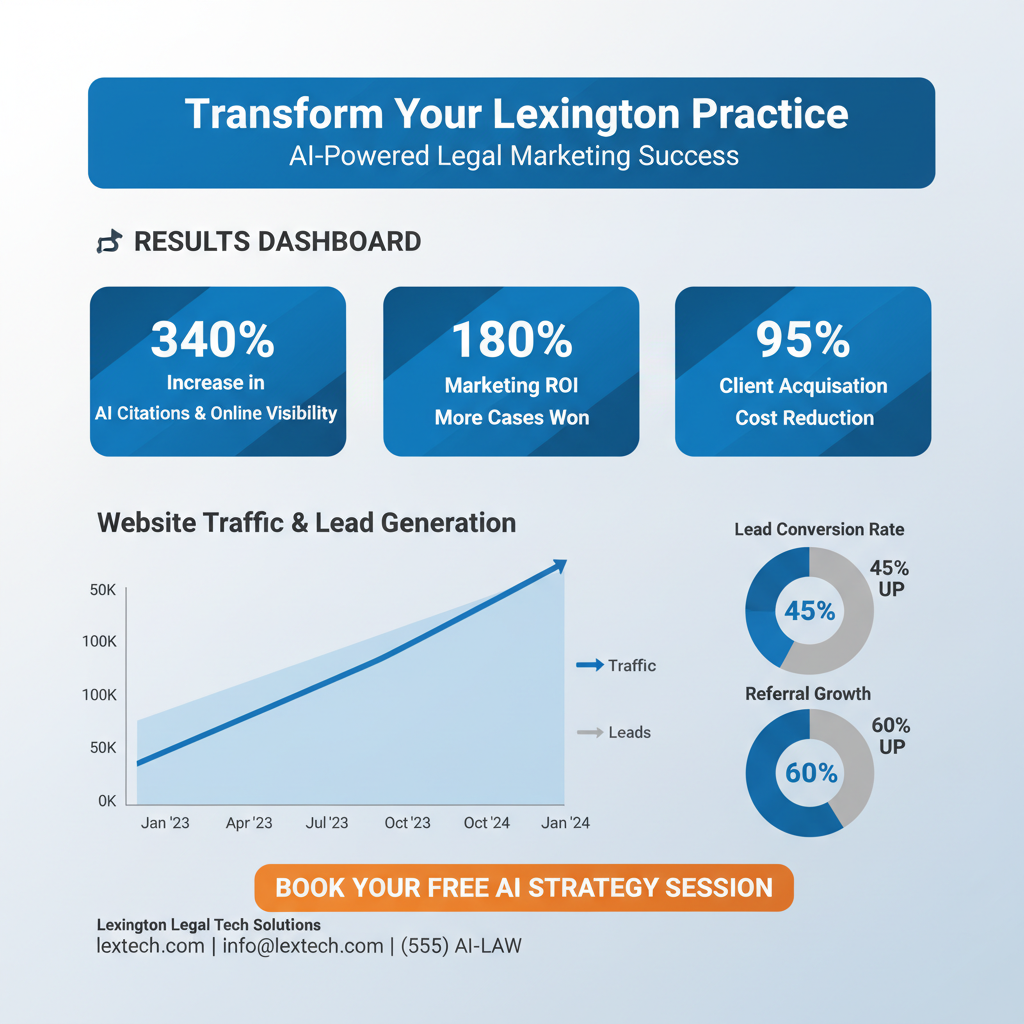
Get a free AI marketing assessment and discover how GEO can drive 340% more qualified client inquiries.
📞 (213) 282-3001 | ✉️ sales@intercore.net
📍 13428 Maxella Ave, Marina Del Rey, CA 90292
Conclusion: Your Next Steps
The transformation of legal client acquisition through AI platforms represents the most significant marketing shift since the internet’s emergence. Lexington law firms that position themselves early in this evolution will capture disproportionate market share as potential clients increasingly rely on AI assistants for attorney recommendations.
The data is unequivocal:
93% of legal professionals now use AI in some capacity
, yet most focus on internal efficiency rather than client-facing optimization. This gap creates unprecedented opportunity for firms willing to invest in comprehensive GEO strategies. With ChatGPT commanding 68-82.7% market share and 800 million weekly users actively seeking AI-generated recommendations, the platform represents the largest untapped client acquisition channel in legal marketing history.
For Lexington attorneys, the path forward requires immediate action. The 6-12 month first-mover advantage window is already narrowing as sophisticated firms begin implementing AI optimization strategies. Firms that delay entry into this market will face increasingly competitive landscapes requiring significantly higher investment to achieve comparable results. Our documented 18:1 to 21:1 ROI figures reflect current market conditions—as competition intensifies, these exceptional returns will normalize to industry standards.
This guide is part of our comprehensive AI Legal Marketing Services by Location resource hub, providing market-specific insights for attorneys across the United States. InterCore Technologies has pioneered AI marketing strategies for legal professionals since 2002, combining enterprise AI development expertise with deep understanding of legal marketing requirements and ethical constraints.