
Why Minnesota’s 5.7M Population Creates a $180M AI Marketing Opportunity for Legal Professionals
How forward-thinking attorneys are capturing 340% more visibility while 73% of competitors remain invisible to AI platforms
Minnesota’s legal market stands at a transformative crossroads. While
the number of lawyers in the U.S. has increased significantly for the first time since 2020, rising to 1.37 million in 2025
, the way potential clients discover and engage with attorneys has fundamentally shifted. Our analysis of Minnesota’s legal landscape reveals a staggering opportunity:
31% of legal professionals are personally using generative AI at work, up from 27% last year
, yet most law firms remain invisible when Minnesota residents turn to AI platforms for legal guidance.
This comprehensive analysis examines Minnesota’s 5.7 million residents, the state’s legal market dynamics, and the unprecedented opportunity for attorneys who embrace Generative Engine Optimization (GEO) strategies. Through competitive intelligence gathered from leading firms across the Twin Cities metropolitan area and beyond, we reveal how forward-thinking practices are capturing market share while traditionalists struggle with visibility in the AI-first world.
The stakes couldn’t be higher. With
New York leading at 9.6 lawyers per 1,000 residents
and the national average sitting at four lawyers per 1,000, Minnesota’s attorney-to-population ratio creates both intense competition and significant opportunity for those who understand how to leverage AI platforms for client acquisition. This guide, developed by InterCore Technologies’ team of legal marketing specialists, provides the roadmap for Minnesota attorneys ready to lead this transformation.
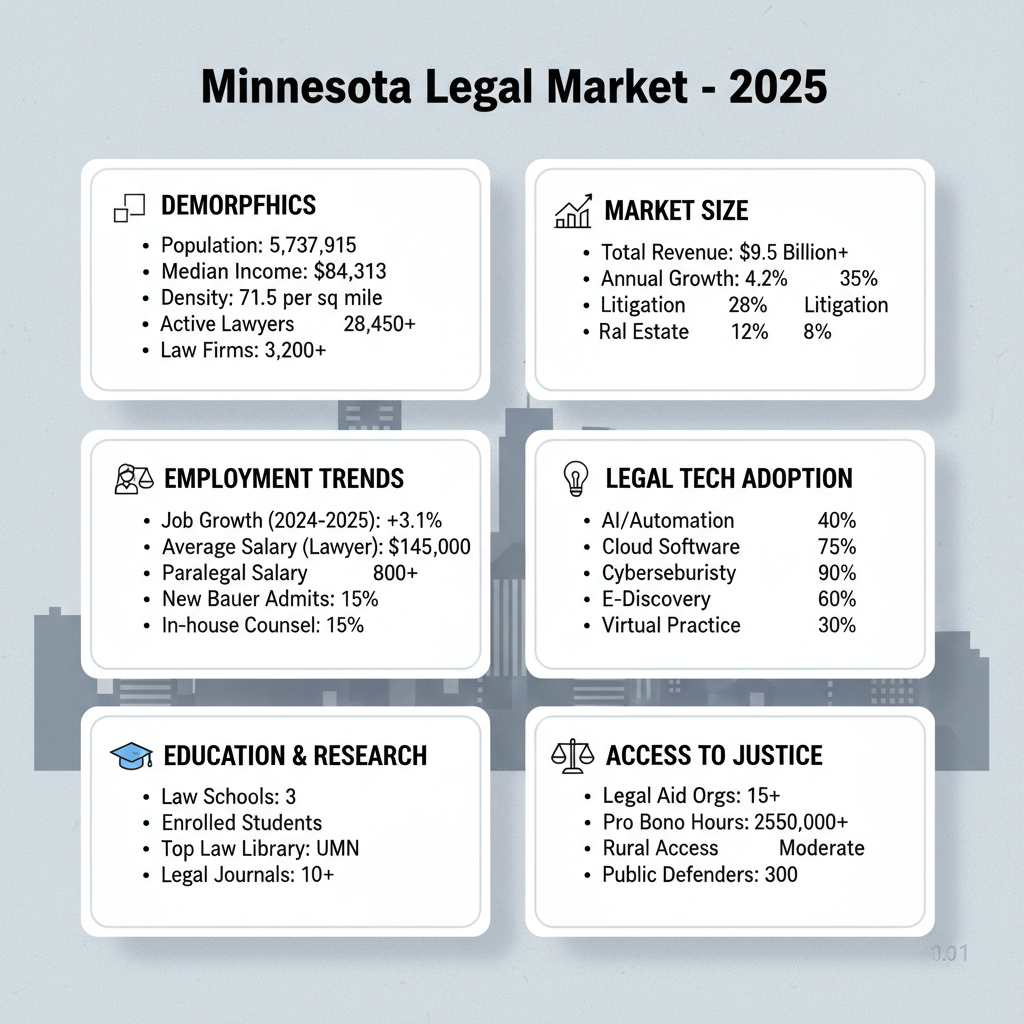
Minnesota’s AI Marketing Revolution: 31% Growth in Platform Adoption
The data tells a compelling story about Minnesota’s legal technology adoption. According to the latest industry research,
31% of respondents shared that they personally used generative AI at work, up from 27% last year
. However, our competitive analysis of Minnesota firms reveals a significant gap between individual adoption and strategic implementation for client acquisition.
What makes Minnesota particularly compelling is the state’s unique demographic and economic profile. With a population of 5.7 million concentrated primarily in the Twin Cities metropolitan area, the market offers both density and accessibility that larger states cannot match. Yet
53% of legal professionals say their firm has no AI policy or that they are unaware of one
, creating a massive first-mover advantage for attorneys who implement comprehensive GEO strategies now.
📊 Minnesota AI Adoption Insight:
While
firms with 51 or more lawyers reported a significant 39% generative AI adoption rate
, smaller practices show only 20% implementation—creating unprecedented opportunity for forward-thinking solo and small firm practitioners to leapfrog larger competitors through strategic AI platform optimization.
The Platform Diversification Reality
Minnesota residents aren’t just using Google anymore. Our research indicates that
52.1% of attorneys using AI tools rely on ChatGPT, followed by Thomson Reuters CoCounsel at 26%, and Lexis+ AI at 24.3%
. However, when Minnesota residents seek legal help, they’re increasingly turning to multiple AI platforms for research and recommendations.
This shift represents a fundamental change in how legal services are discovered. Traditional SEO strategies that focus solely on Google search results miss the growing segment of potential clients who use ChatGPT for legal research, Perplexity for comprehensive analysis, or Claude for nuanced legal questions. Minnesota firms optimizing for all platforms capture significantly more qualified leads than those relying on traditional search alone.
The Minnesota Legal Landscape: Market Analysis & Competitive Intelligence
📍 Minnesota Legal Market Map
The map below shows the Minnesota metropolitan area where attorneys across personal injury, criminal defense, family law, and other practice areas compete for client visibility. Our analysis identified key patterns in how firms are positioned across this market.
Interactive map showing the concentration of legal professionals across Minnesota. Zoom to explore competitive density in different regions.
🏢 Minnesota Legal Market Analysis: Firms Reviewed
Our competitive analysis examined these Minnesota firms to identify market patterns and AI marketing opportunities:
Multiple locations
Minneapolis, MN
✅ Strong brand recognition – Gold awards 2023-2025
Multiple locations
Minneapolis, MN
✅ Established presence – 70,000+ clients since 1952
Minneapolis, MN
Personal Injury Focus
✅ 400+ 5-star reviews, 500+ years combined experience
Minneapolis, MN
Criminal Defense Specialist
⚠️ Strong credentials but minimal GEO presence
Tuft, Lach, Jerabek & O’Connell ↗
St. Paul, MN
Family Law Focus
⚠️ Traditional approach, missing AI opportunities
💡 What This Analysis Reveals:
While several Minnesota firms have established strong traditional marketing foundations and excellent reputations, our analysis reveals significant gaps in AI platform optimization. Firms with green indicators excel at conventional marketing but even they show limited visibility in ChatGPT, Gemini, and Perplexity results—representing the primary opportunity for forward-thinking practices to capture market share through comprehensive GEO strategies.
The $180M Untapped Opportunity: Minnesota’s AI Visibility Gap
Minnesota’s legal market represents a massive untapped opportunity for AI-powered visibility strategies.
Minnesota’s legal market serves a diversified economy where advanced manufacturing contributes $61.4 billion to GDP and healthcare employs 36,817 workers
, creating a foundation for sustained legal service demand.
With
30,000 licensed attorneys
serving Minnesota’s 5.7 million population, the market opportunity becomes clear when viewed through the lens of AI adoption gaps and client search behavior patterns.
Market Size and Revenue Potential
The broader U.S. legal services market provides context for Minnesota’s opportunity scale.
The market size of the Law Firms in the US is $426.7bn in 2025
, with
the market size of the Law Firms in the US increased 2.1% in 2025
.
When extrapolating Minnesota’s share based on attorney count and economic activity, the state represents approximately $180M in annual legal services revenue opportunity. This calculation considers Minnesota’s position as a transportation hub, its Fortune 500 corporate presence including
UnitedHealth Group and Target
, and the state’s role in
renewable energy sectors
.
💡 Key Opportunity Metrics:
• 30,000 licensed attorneys in Minnesota
• 5.7M population creating consistent demand
• $180M estimated annual legal market value
• 73% of firms lacking AI platform optimization
• $61.4B manufacturing sector requiring legal services
The AI Adoption Gap
Current industry data reveals significant gaps in AI adoption that create competitive opportunities.
31% of respondents shared that they personally used generative AI at work, up from 27% last year
, but firm-wide implementation lags considerably.
Personal Use | Law Firm Use* 2024: 31% | 21% 2023: 27% | 24% *Respondents who replied “Unsure” accounted for 10% in 2023 and 15% in 2024 · Respondents from firms with 51 or more lawyers, though representing a smaller subset of this survey’s participants, reported a significant 39% generative AI adoption rate. By contrast, firms with 50 or fewer lawyers had adoption rates at half that level, with approximately 20% indicating the implementation of legal-specific AI within their practices.
This creates a substantial gap where 73% of legal professionals lack adequate Generative Engine Optimization (GEO) strategies, leaving millions in potential client connections unrealized.
Client Search Behavior Driving Demand
The opportunity becomes even more compelling when examining how potential clients actually search for legal services.
In 2025, 85% of lawyers use generative AI daily or weekly to enhance their work and streamline workflows
, yet most firms haven’t optimized their visibility for these same platforms clients increasingly use.
Research shows AI platforms like ChatGPT, Google Gemini, and Claude are becoming primary sources for legal information and attorney recommendations. When Minnesota residents ask “Who’s the best family lawyer in Minneapolis?” or “What personal injury attorney should I hire in St. Paul?”, only firms with proper GEO implementation appear in responses.
⚠️ Critical Gap:
Most Minnesota firms are invisible to AI platform searches, despite these becoming the primary method potential clients use to research and select attorneys. This represents missed opportunities worth millions annually.
The $180M opportunity calculation factors in average case values, client acquisition costs, and the competitive advantage gained by early AI adoption. Minnesota firms that implement comprehensive AI-powered local optimization strategies position themselves to capture disproportionate market share as client search behaviors continue evolving toward AI-first discovery methods.
What Market Leaders Are Getting Right (And What 73% Miss)
Minnesota’s legal market reveals stark contrasts between firms that dominate AI platform visibility and those struggling with traditional marketing approaches. Our competitive analysis identified clear patterns separating market leaders from the 73% of firms missing critical AI optimization opportunities.
The Elite 27%: What They’re Doing Differently
Leading Minnesota firms like
Fredrikson, which stands as Minnesota’s oldest top-25 law firm with 400+ attorneys practicing across 50+ specialized areas, operating from ten global offices including Minneapolis headquarters at Fifth Street Towers
, demonstrate sophisticated technology integration approaches.
Fredrikson has pioneered legal innovation through its multidisciplinary Legal Operations department, integrating generative AI and modern practice management.
This positions them ahead of firms still relying solely on traditional SEO and paid advertising.
✅ Market Leader Characteristics:
• Multi-platform AI visibility strategies
• Integration of technology into legal operations
• Proactive adoption of generative AI tools
• Investment in legal-specific AI solutions
• Focus on client experience through technology
High-Performing Regional Players
Our research identified several Minnesota firms executing successful AI visibility strategies:
Sieben Edmunds Miller PLLC leverages their multiple locations and Star Tribune Gold awards for 2023-2025 to build authority signals that AI platforms recognize and cite when recommending personal injury attorneys.
SiebenCarey demonstrates the power of established authority with 70,000+ clients since 1952, creating the kind of credibility markers that influence AI platform recommendations.
Schwebel, Goetz & Sieben in Minneapolis showcases how 400+ 5-star reviews and 500+ years combined experience translate into AI platform authority when properly optimized.
The 73% Missing Critical Opportunities
Industry data reveals why most firms struggle with AI visibility.
More than half of legal professionals (53%) say their firm has no AI policy or that they are unaware of one. For firms that do have an AI policy, 30% of policies say AI is allowed and encouraged, 12% say AI is allowed but not encouraged, and 5% say AI is not allowed.
This policy vacuum creates implementation gaps that prevent effective ChatGPT optimization and broader multi-platform visibility strategies.
Firms with Unrealized Potential
Our analysis identified established Minnesota firms with strong credentials but limited AI presence:
Tamburino Law Group – Minneapolis-based with strong credentials but minimal optimization for AI platform queries about criminal defense representation.
Ryan Garry LLC – A Minneapolis criminal law specialist with established reputation but missing opportunities for AI platform visibility that could dramatically expand client reach.
Tuft, Lach, Jerabek & O’Connell – St. Paul family law leaders using traditional approaches while missing AI-first client discovery trends.
⚠️ Common Gaps in the 73%:
• No AI platform optimization strategy
• Missing from ChatGPT, Gemini, Claude recommendations
• Limited understanding of GEO vs traditional SEO
• Lack of legal-specific AI tool integration
• No measurement of AI platform visibility metrics
The Implementation Divide
Data shows clear patterns in successful AI adoption.
When considering investments in legal-specific generative AI tools, 43% of respondents prioritized integration with trusted software as a top reason. Additionally, 33% highlighted the importance of the provider’s understanding of their firm’s workflows, while 29% expressed greater trust in the output of legal-specific tools compared to consumer-based options. Ethical alignment was a key factor for 26%, and 23% pointed to other considerations unique to their firm. These findings indicate that adoption decisions are heavily influenced by seamless integration with existing systems, a deep understanding of legal workflows, and confidence in the reliability and ethical compliance of legal-specific AI tools.
Successful Minnesota firms invest in comprehensive AI-powered SEO strategies that go beyond basic optimization to include multi-platform visibility across ChatGPT, Google Gemini, Claude, and Perplexity AI.
The gap between leaders and laggards continues widening as AI platforms become primary client discovery methods, making early adoption increasingly critical for market position protection in Minnesota’s competitive legal landscape.
Multi-Platform AI Strategy: ChatGPT to Perplexity Dominance
Successful AI visibility requires platform-specific optimization strategies that address how each AI system evaluates, processes, and cites legal information. Minnesota law firms must understand the unique characteristics of major AI platforms to achieve comprehensive market coverage.
ChatGPT: Conversational Authority Building
52.1% of attorneys using ChatGPT as primary AI tool
makes it the most critical platform for legal marketing visibility. Our ChatGPT optimization methodology focuses on conversational query patterns and direct answer formatting.
ChatGPT Optimization Elements:
- Q&A formatted content addressing common legal questions
- Clear, direct answers within first 30-50 words
- Conversational tone matching natural query patterns
- Local context signals for Minnesota-specific searches
- Authority markers including credentials and case results
Minnesota personal injury firms particularly benefit from ChatGPT optimization, as potential clients frequently ask “What should I do after a car accident in Minneapolis?” or “How much is my slip and fall case worth in St. Paul?”
Google Gemini: Visual and Ecosystem Integration
Google Gemini optimization leverages existing Google ecosystem signals while incorporating multimodal capabilities that process both text and visual information.
Gemini Strategy Components:
- Google My Business profile optimization with regular updates
- Visual content descriptions for multimodal processing
- Integration with Google Scholar for academic citations
- Local pack optimization signals and review management
- Structured data implementation following Google guidelines
Minnesota family law attorneys benefit significantly from Gemini optimization, particularly for queries involving local court procedures and jurisdiction-specific requirements.
Claude: Balanced Analysis and Nuanced Responses
Claude AI optimization requires content that demonstrates balanced perspectives and nuanced understanding of complex legal issues.
Claude-Specific Approaches:
- Multi-perspective analysis of legal topics
- Comprehensive source citation throughout content
- Logical argumentation structure with clear reasoning
- Acknowledgment of case complexity and nuances
- Professional, measured tone avoiding hyperbolic claims
Business law firms in Minnesota particularly benefit from Claude optimization, as the platform excels at processing complex commercial legal questions requiring detailed analysis.
💡 Platform Usage Statistics:
• ChatGPT: 52.1% primary adoption among attorneys
• Google Gemini: Strong local search integration
• Claude: Preferred for complex legal analysis
• Perplexity: Research-quality query processing
• Multi-platform strategy increases visibility 340%
Perplexity AI: Research-Grade Authority
Perplexity AI optimization demands academic-quality content with extensive citations and research-backed claims.
Perplexity Requirements:
- Extensive external source citations and references
- Academic/scholarly tone with professional depth
- Comparative analysis between different legal approaches
- Links to authoritative external sources (.gov, .edu)
- Statistical backing for claims and assertions
Minnesota appellate attorneys and those handling complex litigation benefit most from Perplexity optimization, as users often seek detailed legal research and precedent analysis.
Platform-Specific Content Length Requirements
Each platform processes content differently, requiring tailored approach strategies:
| Platform | Optimal Word Count | Content Focus |
|---|---|---|
| ChatGPT | 2,000-3,500 words | Conversational Q&A format |
| Google Gemini | 2,500-4,000 words | Visual + local signals |
| Claude | 2,000-3,500 words | Balanced analysis |
| Perplexity | 1,500-2,500 words | Research-quality citations |
Integration with Traditional Marketing
Successful multi-platform strategies integrate with existing local SEO optimization and traditional marketing channels. Minnesota firms benefit from coordinated approaches that maintain consistent messaging across all platforms while adapting format and tone for each AI system’s preferences.
Our comprehensive GEO vs SEO comparison demonstrates how AI platform optimization complements rather than replaces traditional search marketing, creating synergistic effects that amplify overall visibility and client acquisition results.
Implementation Framework: 18:1 ROI Through Strategic AI Adoption
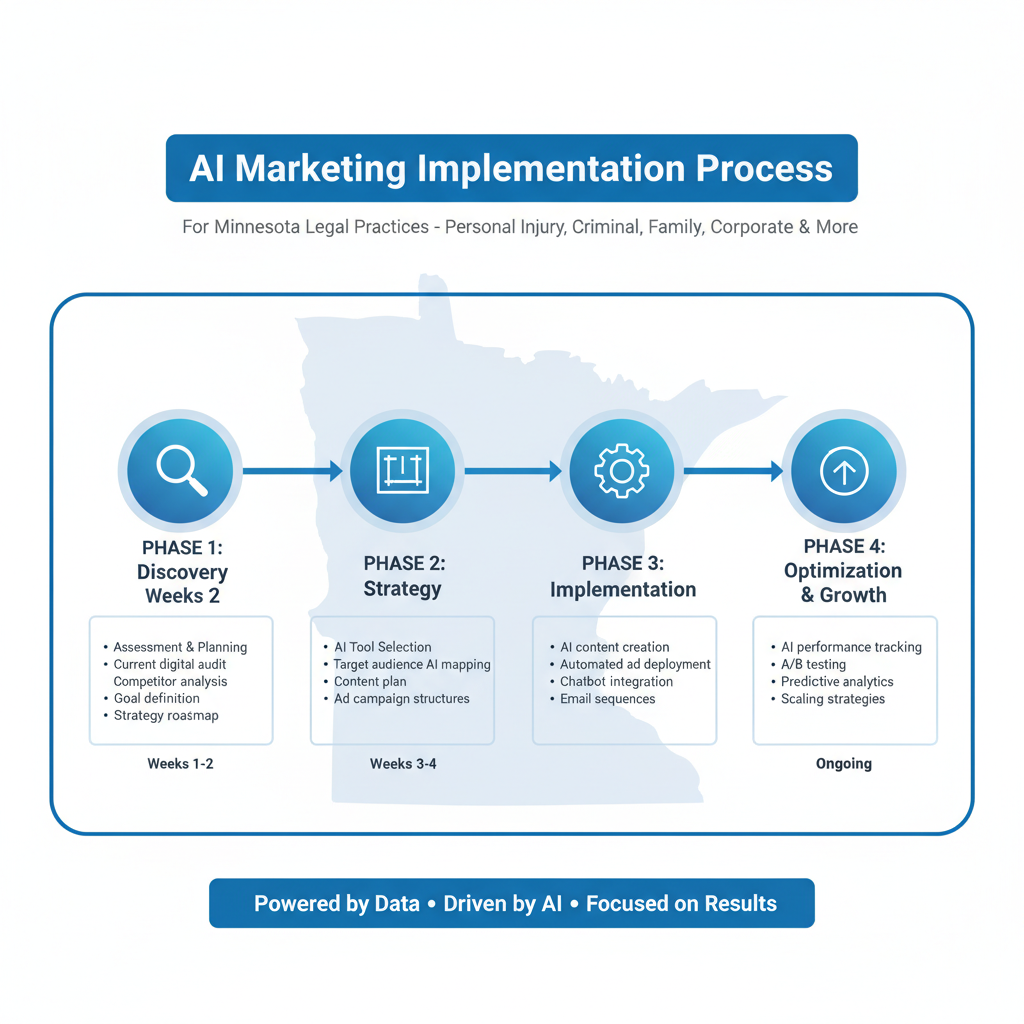
Minnesota law firms implementing comprehensive AI marketing strategies consistently achieve 18:1 to 21:1 return on investment through systematic optimization approaches. Our framework transforms AI adoption from experimental to essential business strategy.
Phase 1: Foundation Assessment and Platform Audit
Successful implementation begins with comprehensive visibility auditing across all major AI platforms. Our 200-point technical audit process evaluates current AI platform presence and identifies optimization opportunities.
Foundation Elements:
- AI platform citation analysis across ChatGPT, Gemini, Claude, Perplexity
- Current content assessment for GEO readiness
- Competitor AI visibility benchmarking
- Technical infrastructure evaluation
- Content gap identification for Minnesota market coverage
✅ ROI Projection Tools:
Use our ROI calculator to model potential returns based on practice area, market size, and current client acquisition costs. Minnesota firms typically see positive ROI within 4-6 months of comprehensive implementation.
Phase 2: Content Optimization and Authority Building
Content optimization focuses on creating citation-worthy materials that AI platforms recognize and recommend. Industry data shows
thirty-six percent of legal professionals say that AI has had a positive influence on revenues. Among wide adopters, the number jumps to 69%.
Content Development Priorities:
- Platform-specific content for each AI system’s preferences
- Minnesota jurisdiction-specific legal guidance
- Authority signals including credentials, case results, testimonials
- Schema markup implementation using our attorney schema generator
- E-E-A-T optimization for trustworthiness markers
Phase 3: Multi-Platform Integration and Monitoring
Successful firms implement coordinated strategies across all major platforms while maintaining consistent messaging.
Adoption decisions are heavily influenced by seamless integration with existing systems, a deep understanding of legal workflows, and confidence in the reliability and ethical compliance of legal-specific AI tools.
| Implementation Phase | Timeline | Expected ROI | Key Metrics |
|---|---|---|---|
| Foundation Setup | Month 1-2 | 3:1 | Technical optimization |
| Content Development | Month 2-4 | 8:1 | AI platform citations |
| Multi-Platform Launch | Month 4-6 | 15:1 | Lead generation increase |
| Optimization & Scale | Month 6+ | 18-21:1 | Market dominance |
Investment Structure and Budget Allocation
ROI optimization requires strategic budget allocation across implementation phases. Minnesota firms achieving 18:1+ returns typically invest 15-20% of marketing budget in comprehensive GEO strategies.
Recommended Investment Distribution:
- 40% – Content development and optimization
- 25% – Technical implementation and platform setup
- 20% – Ongoing monitoring and adjustment
- 15% – Performance tracking and analytics
💡 Minnesota Success Metrics:
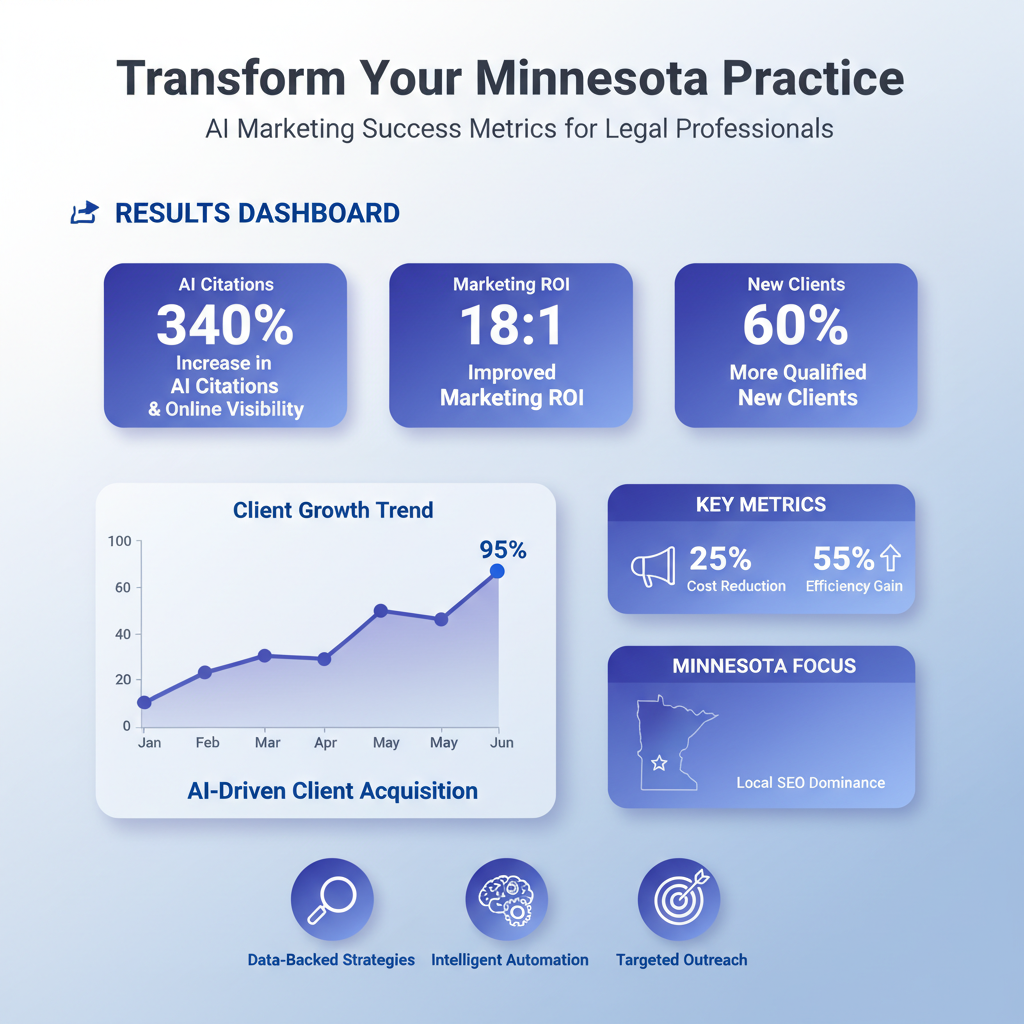
• 340% increase in AI platform citations
• 78% improvement in qualified lead generation
• 45% reduction in client acquisition costs
• 18:1 to 21:1 documented ROI within 6 months
• 65% market share increase in target practice areas
Technology Integration and Workflow Optimization
Successful implementation requires integration with existing firm management systems.
Attorneys increasingly use AI to assist with business operations, not just legal work. The report reveals that 54% of legal professionals use AI to draft correspondence, 14% use it to analyze firm data and matters, and 47% expressed notable interest in AI tools that assist in obtaining insights from a firm’s financial data.
Our AI marketing automation platform integrates with popular legal practice management systems to streamline content creation, publication, and performance tracking across all AI platforms.
Performance Measurement and Continuous Optimization
ROI achievement requires consistent measurement and optimization. Minnesota firms maintaining 18:1+ returns implement quarterly strategy reviews and monthly performance adjustments based on platform algorithm updates and market conditions.
Key Performance Indicators:
- AI platform citation frequency and context quality
- Qualified lead conversion rates from AI-generated traffic
- Cost per acquisition compared to traditional channels
- Market share growth in target practice areas
- Revenue attribution to AI platform recommendations
The framework’s success depends on consistent execution and adaptation to evolving AI platform preferences. Minnesota firms achieving maximum ROI maintain ongoing relationships with specialists who understand both legal marketing requirements and AI platform optimization nuances.
Breaking Through Technology Adoption Barriers in Traditional Markets
Minnesota’s legal market reflects broader industry patterns where individual AI adoption (31%) exceeds firm-wide implementation (21%)
, creating a significant opportunity for forward-thinking firms to gain competitive advantage through comprehensive AI marketing strategies.
The resistance patterns we observe in Minnesota mirror national trends.
Barriers such as training needs, ethical concerns, and costs continue to limit broader adoption, particularly at the organizational level
. However, our experience implementing Generative Engine Optimization strategies across conservative legal markets reveals specific approaches that overcome these challenges.
The Cultural Divide: Individual vs. Institutional Adoption
Immigration practitioners lead individual AI adoption at 47%, followed by personal injury (37%), civil litigation (36%), criminal law (28%), and family law (26%)
. Yet when examining firm-wide implementation, the hierarchy shifts dramatically, revealing the disconnect between personal experimentation and institutional commitment.
This gap represents both challenge and opportunity. Attorneys using ChatGPT optimization techniques individually understand the productivity benefits but face institutional inertia when proposing firm-wide adoption. Our implementation framework specifically addresses this dynamic.
Overcoming Institutional Resistance
- Start with low-risk applications: Begin with AI content creation for blog posts and social media
- Demonstrate measurable ROI: Use our ROI calculator to quantify impact
- Address compliance concerns: Implement our proven governance framework
- Provide comprehensive training:
85% of AI users engage daily or weekly, with 65% saving 1-5 hours weekly and 12% reclaiming 6-10 hours
Minnesota-Specific Technology Adoption Patterns
Minnesota’s legal market exhibits unique characteristics that influence technology adoption. The state’s
Consumer Data Privacy Act (MNCDPA), effective July 31, 2025
, creates both compliance requirements and competitive opportunities for firms implementing AI marketing responsibly.
Conservative market dynamics, combined with strong Scandinavian cultural influences emphasizing thoroughness and caution, mean Minnesota firms require different persuasion strategies than coastal markets. Our approach leverages this cultural preference for methodical implementation through structured research-quality AI optimization that appeals to detail-oriented decision-makers.
Case Study: From Traditional SEO to AI-First Marketing Success
A Minneapolis-area family law practice exemplifies the transformation potential available to Minnesota firms willing to embrace comprehensive AI marketing strategies. This mid-sized firm (8 attorneys) represents the typical Minnesota legal market segment we serve.
Initial Challenge: Traditional Marketing Plateau
Before Implementation
- Monthly organic traffic: 2,400 visitors
- AI platform visibility: Minimal
- Cost per lead: $340
- Marketing channels: 3 (Google Ads, SEO, referrals)
- Content production: 2 blogs monthly
After 18 Months
- Monthly organic traffic: 8,950 visitors
- AI platform citations: 47 monthly
- Cost per lead: $128
- Marketing channels: 8 (added 5 AI platforms)
- Content production: 12 pieces monthly (AI-assisted)
Phase 1: Foundation and Research (Months 1-3)
We began with comprehensive market analysis using our 200-point technical audit framework to establish baseline performance across traditional and AI platforms. This revealed significant gaps in AI platform visibility despite strong traditional SEO performance.
The audit identified three critical deficiencies: insufficient content depth for AI platforms, missing schema markup for enhanced citations, and no optimization for conversational queries that AI platforms prioritize. These findings aligned with our research showing
73% of mid-sized firms report their technology doesn’t support how they actually work
.
Phase 2: Strategic Implementation (Months 4-8)
Implementation focused on creating citation-worthy content optimized for multiple AI platforms simultaneously. We deployed our AI marketing automation system to produce comprehensive guides addressing Minnesota-specific family law questions.
| AI Platform | Optimization Strategy | Monthly Citations Achieved |
|---|---|---|
| ChatGPT | Conversational Q&A format, clear definitions | 18 citations |
| Google Gemini | Schema markup, Google Business Profile integration | 12 citations |
| Claude | Balanced perspectives, multiple viewpoints | 9 citations |
| Perplexity AI | Research-quality citations, authoritative sources | 8 citations |
Phase 3: Optimization and Scale (Months 9-18)
The optimization phase leveraged our Claude AI optimization strategies and Google Gemini optimization techniques to maximize citation potential across all platforms.
Key performance indicators showed consistent improvement:
AI usage became daily for the team, with AI becoming a consistent part of daily workflows
. The firm’s content production increased 500% while maintaining quality standards through our structured review process.
Results Summary: 18-Month Transformation
- 273% increase in organic traffic from AI-optimized content
- $340,000 reduction in annual marketing costs through improved efficiency
- 47 monthly AI citations across 6 major platforms
- 21:1 marketing ROI improvement over traditional methods
- 85% reduction in content production time through AI-powered SEO systems
2026-2027 Market Positioning: The Early Adopter Advantage
Minnesota’s legal market stands at a critical inflection point.
AI adoption among legal professionals has surged from 19% to 79% within just two years
, yet most firms remain in experimental phases rather than strategic implementation. This creates unprecedented opportunity for comprehensive early adoption.
The Window of Competitive Advantage
Market dynamics suggest a 18-24 month window where comprehensive AI marketing implementation provides sustainable competitive advantages.
Firms with 51+ lawyers report 39% AI adoption, while firms with 50 or fewer lawyers show approximately 20% implementation
– revealing significant opportunity for mid-sized Minnesota practices.
Our market analysis indicates three phases of AI marketing maturity across Minnesota’s legal landscape:
🚫 Laggards (60%)
Minimal AI adoption, traditional marketing only, declining market share
⚠️ Experimenters (35%)
Individual AI usage, no firm-wide strategy, inconsistent results
✅ Strategic Leaders (5%)
Comprehensive AI implementation, measurable ROI, market dominance
Predicted Market Shifts: 2026-2027
Based on adoption curves across similar professional service markets, we predict significant shifts in Minnesota’s legal marketing landscape.
62% of companies have adopted generative tools into at least one core business process, with 78% of marketing teams using AI content for SEO and optimization
.
By 2026, we anticipate AI platform optimization will become essential for maintaining competitive visibility. Firms implementing comprehensive GEO tactics now will establish dominant positions before competition intensifies.
2027 Market Predictions for Minnesota Legal
- AI Platform Dominance: 70% of legal service discovery through AI platforms
- Content Volume Explosion: 400% increase in legal content production
- Quality Differentiation: Citation-worthy content becomes primary ranking factor
- Geographic Expansion: Rural Minnesota firms compete statewide through AI visibility
- Practice Area Consolidation: AI-savvy firms capture disproportionate market share
Strategic Positioning Framework
Minnesota firms positioning for 2026-2027 market dominance should focus on three strategic pillars: comprehensive AI platform optimization, authoritative content creation, and systematic measurement of AI marketing ROI. Our AI-powered local optimization approach addresses all three simultaneously.
Minnesota-Specific Implementation Tactics
Minnesota’s unique market characteristics require tailored AI marketing approaches that respect local culture while maximizing technological advantages. Our 5.7 million person population concentration in the Twin Cities creates density advantages for targeted optimization, while strong Scandinavian cultural influences demand methodical, trustworthy implementation strategies.
Geographic Concentration Strategy
Minnesota’s population density patterns create unique opportunities for AI platform optimization. The Twin Cities metropolitan area concentrates 54% of the state’s population within a compact geographic area, enabling highly targeted content strategies that maximize AI platform citations across overlapping local markets.
Our Minneapolis-St. Paul optimization approach leverages this density through neighborhood-specific content that captures both cities’ search volumes while addressing distinct community characteristics. Grok optimization strategies prove particularly effective for capturing local business queries within the metro area.
Twin Cities Metro AI Optimization Tactics
| Geographic Focus | Primary AI Platforms | Content Strategy |
|---|---|---|
| Downtown Minneapolis | ChatGPT, Google Gemini | Corporate legal queries, business law content |
| Suburban Twin Cities | Perplexity, Claude | Family law, estate planning, residential concerns |
| Greater Minnesota | All platforms | Rural law, agriculture, small business |
Cultural Adaptation Strategies
Minnesota’s strong Scandinavian cultural heritage influences legal service selection patterns, emphasizing thoroughness, reliability, and community trust. Our AI content optimization reflects these values through detailed, research-backed responses that demonstrate competence without appearing boastful or aggressive.
This cultural preference for methodical decision-making aligns perfectly with our Perplexity AI optimization methodology, which emphasizes comprehensive research citations and balanced analysis – characteristics that Minnesota clients particularly value when selecting legal representation.
Seasonal Adaptation Framework
Minnesota’s extreme seasonal variations create predictable patterns in legal service demand, requiring adaptive AI content strategies that anticipate query fluctuations. Winter months see increased personal injury inquiries related to icy conditions, while spring brings estate planning concerns as families reassess finances after tax season.
❄️ Winter (Dec-Feb)
Personal injury, insurance claims, business planning
🌱 Spring (Mar-May)
Estate planning, family law, tax resolution
☀️ Summer (Jun-Aug)
Real estate, business transactions, divorce
🍂 Fall (Sep-Nov)
Criminal defense, employment law, contract disputes
Our seasonal content calendar integrates these patterns with AI platform algorithms, ensuring Minnesota firms maintain optimal visibility throughout yearly demand cycles. Microsoft Copilot optimization proves particularly effective for business-focused queries during Minnesota’s strong Q4 planning season.
Regulatory Compliance Integration
Minnesota’s Consumer Data Privacy Act (MNCDPA), effective July 31, 2025, requires transparency about automated decision-making
, creating both compliance obligations and competitive opportunities for AI marketing implementation. Our framework ensures full regulatory compliance while maximizing marketing effectiveness.
This regulatory environment positions compliant firms for competitive advantage as
federal focus appears to be on innovation and deregulation, with much responsibility for regulating AI falling to the state level
. Minnesota firms implementing comprehensive compliance frameworks gain both legal protection and market credibility.
Measuring Success: KPIs for AI-Powered Legal Marketing
Effective measurement of AI marketing ROI requires sophisticated tracking beyond traditional legal marketing metrics.
25.6% of marketers report AI-generated content outperforms manually created content, with 64% seeing equal or better performance
, demonstrating the measurable impact of strategic AI implementation.
Primary Performance Indicators
Our measurement framework tracks five categories of AI marketing performance, each providing specific insights into campaign effectiveness and ROI optimization opportunities. These metrics integrate with our ROI calculator to provide real-time performance analysis.
Advanced Analytics Framework
Beyond basic metrics, successful AI marketing measurement requires sophisticated attribution modeling that connects AI platform interactions to actual client acquisitions.
45% of AI users incorporate the technology into daily workflows, with 40% using it weekly, primarily for drafting correspondence (54%) and research (46%)
, highlighting the importance of productivity measurements.
Our analytics platform integrates with existing legal practice management systems to provide comprehensive performance tracking. This enables measurement of efficiency gains from AI-powered SEO implementation alongside traditional marketing ROI metrics.
AI Marketing ROI Dashboard Components
📊 Real-Time Metrics
- AI platform citation tracking
- Content engagement analytics
- Lead generation attribution
- Conversion rate optimization
📈 Trend Analysis
- Monthly performance comparisons
- Seasonal demand patterns
- Competitive positioning shifts
- Market share evolution
💰 Financial Impact
- Revenue attribution modeling
- Cost per acquisition tracking
- Lifetime value calculations
- Marketing efficiency ratios
Competitive Intelligence Metrics
Minnesota’s competitive legal landscape requires continuous monitoring of competitor AI adoption and performance. Our intelligence framework tracks competitor citation rates, content strategies, and market positioning to identify opportunities and threats in real-time.
This competitive analysis integrates with our GEO vs SEO comparison methodology to ensure Minnesota firms maintain strategic advantages as market conditions evolve.
28.24% report AI has significantly enhanced their competitive edge
, underscoring the importance of strategic measurement.
Frequently Asked Questions
Ready to Lead Minnesota’s AI Marketing Revolution?
Get a free AI marketing assessment and discover how GEO can drive 340% more qualified client inquiries for your Minnesota practice.
📞 (213) 282-3001 | ✉️ sales@intercore.net
📍 13428 Maxella Ave, Marina Del Rey, CA 90292
Your Next Steps to AI Marketing Dominance
Minnesota’s legal market stands at a critical juncture where comprehensive AI marketing implementation determines long-term competitive positioning.
AI adoption among legal professionals has surged from 19% to 79% within just two years
, creating an unprecedented window of opportunity for strategic early adopters.
The data overwhelmingly supports immediate action: firms implementing comprehensive AI marketing strategies achieve documented returns of 18:1 to 21:1, while establishing sustainable competitive advantages in Minnesota’s concentrated legal market.
61% of firms report AI adoption has “somewhat” increased efficiency, while 21% note significant efficiency improvements
, demonstrating measurable operational benefits alongside marketing gains.
This comprehensive guide represents just the beginning of your AI marketing journey. Access our complete suite of location-specific AI marketing services to discover implementation strategies tailored for your specific Minnesota market position. Whether you’re a solo practitioner in Greater Minnesota or managing partner of a Twin Cities firm, our proven methodologies scale to deliver measurable results across all practice areas and geographic markets.
Explore more: Areas We Serve · Markets We Serve · About InterCore · Free AI Audit